
Freeze-Dryers for Confectionery and Freeze-Dried Candy
Candy is already low in moisture. You are removing 100 to 200 grams of water per kilo loaded, not nine hundred, so almost none of the mass you paid for leaves as vapour.
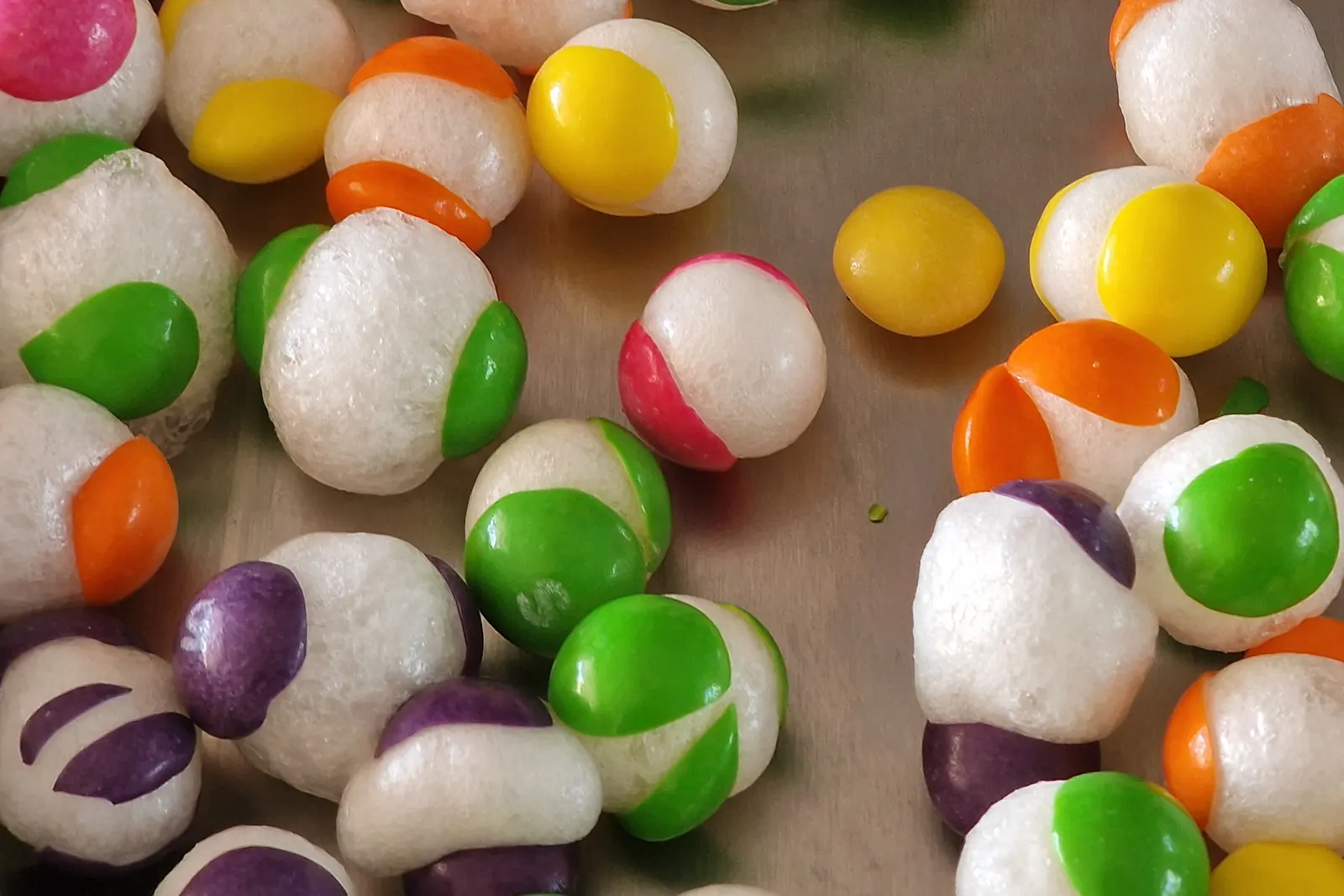
It also does not work the way the name suggests. There is almost no freezable water in a sweet, so nothing sublimes. The machine warms the piece, pulls vacuum until the water inside flashes to vapour and inflates it, then cools it under vacuum so the expanded structure sets. The trade calls the result freeze-dried candy and so do we, because that is the name it sells under. But the process is expansion, and knowing that is the difference between a puffed piece and a shrunken one.
Our own price reference puts freeze-dried gummies at €140 a kilo typical at retail and €70 as a B2B reference. Bulk unbranded gummies list at €4,14 to €5,46 a kilo in Spanish shops, so roughly €6 of sweet sits inside a finished kilo. That gap is why several hundred micro-brands entered this category in three years.
This page gives you the yield table, the price bands, the temperature that governs the process, and the labelling and trade mark problems nobody in this category warns you about.
In short
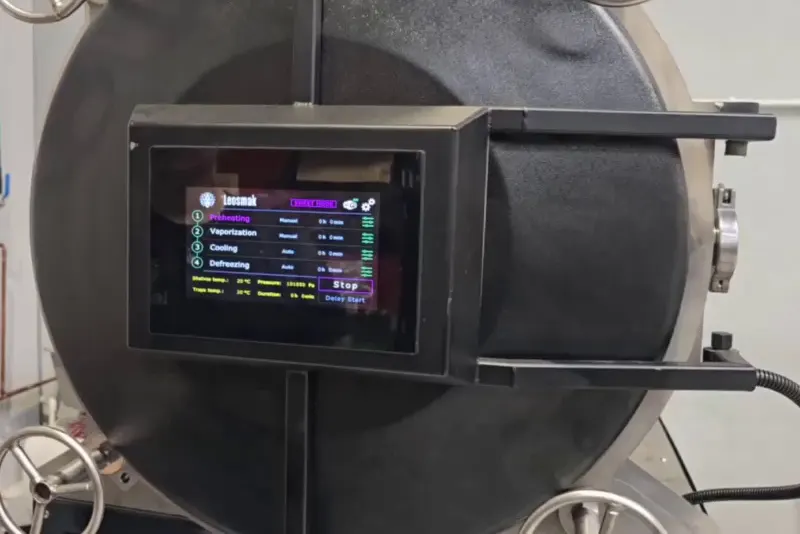
Watch a sweets cycle, start to finish
Send us 2 kg. Get measured yield and cycle figures.
Recipes differ by sugar composition, and sugar composition sets the temperature you can run at. Two gummies that look identical can behave differently in the chamber: one puffs, one stays tacky, and no specification sheet will tell you which.
Send us the sweet you actually intend to sell. We run it on the sweets cycle, weigh it in and out, tell you what a loaded tray really holds, and give you a machine recommendation across all three manufacturers, plus the dried sample itself. If your product is a poor candidate, and hard candy usually is, that is what we will tell you.
Before you post anything, send us your company name, the delivery address and your expected weekly volume. We need the address to return the sample, and the volume because a yield figure without a batch plan is a number you cannot use. It costs you nothing.
Which freeze-dryer for your scale
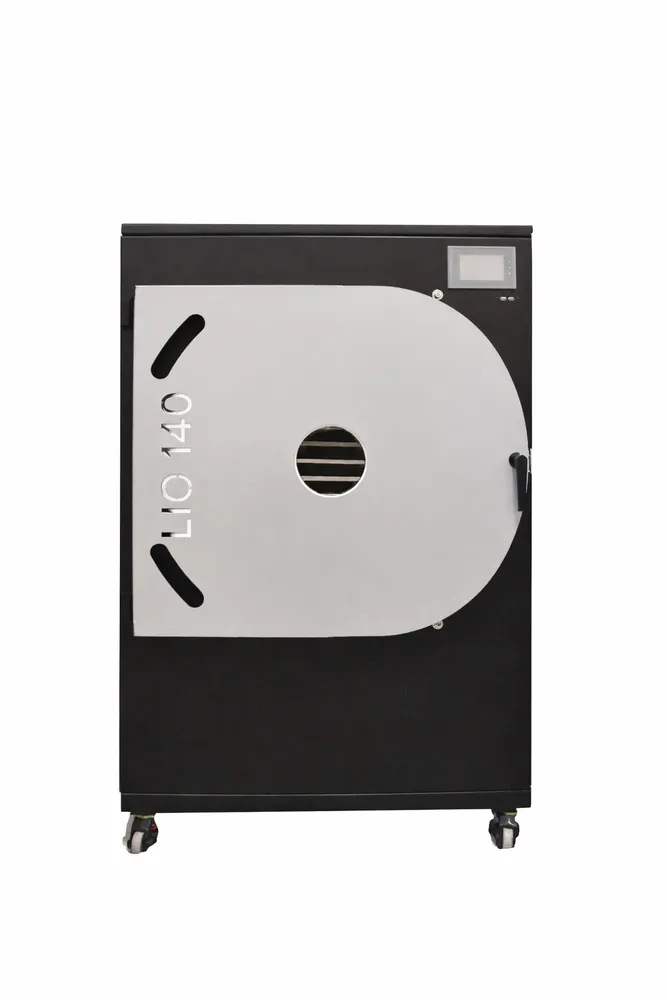
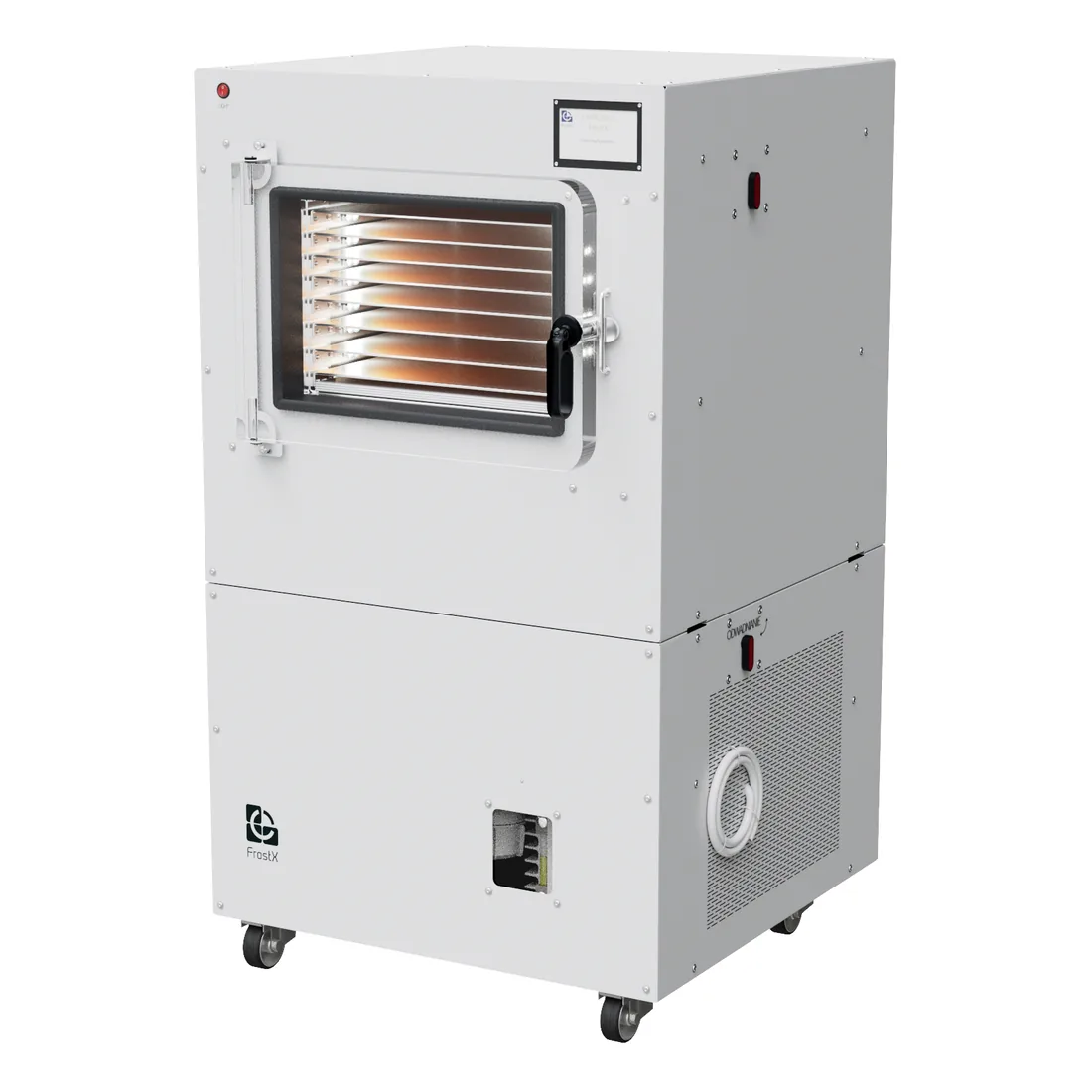
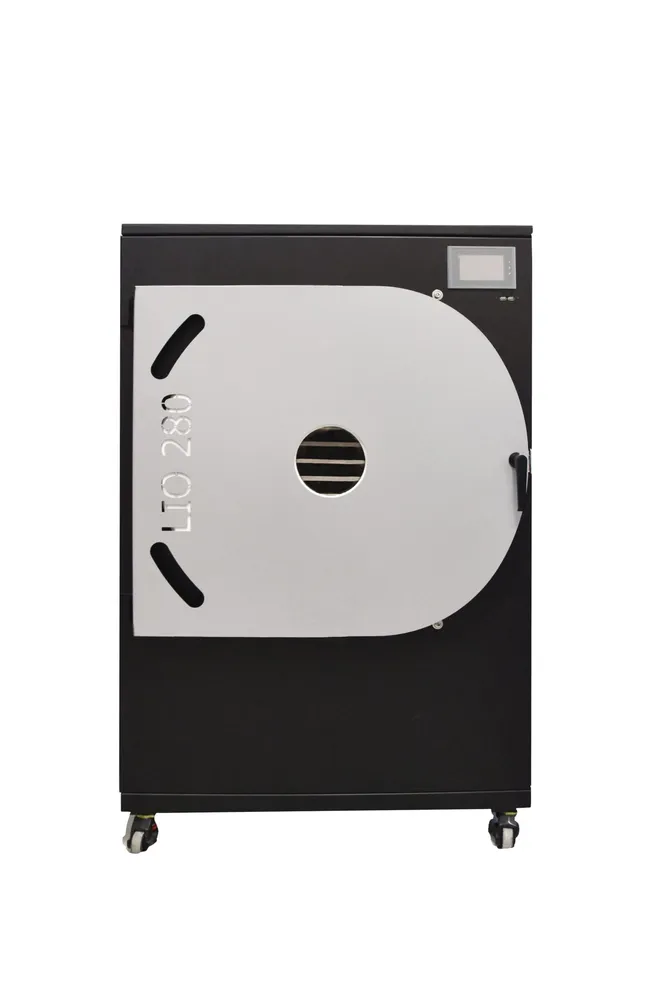
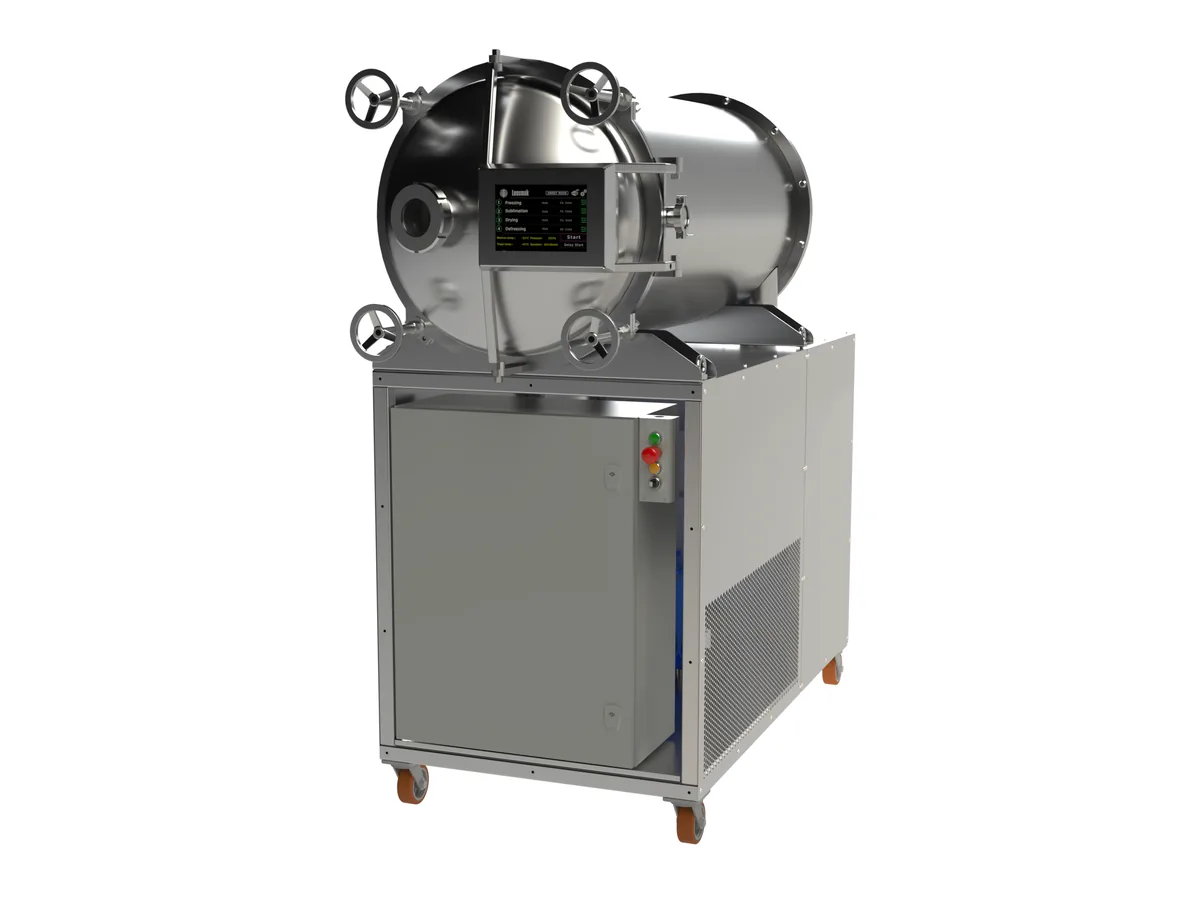
Capacity is quoted as fresh load per batch, meaning what goes in wet. On candy that number flatters the machine, because tray area runs out first and the pieces expand into it. Prices are ex-VAT list prices, pulled live from the catalogue. Every machine here can run a sweets cycle.
| Stage | Fresh load per batch | Running cost | From | Representative models |
|---|---|---|---|---|
| Compact commercialR&D, first line, market stall, replacing a hobby unit | Up to 10 kg | 0,9–1,4 kWh/h | €4.950 | |
| Light commercialfirst production line, steady weekly orders | Up to 18 kg | 1,4–2,46 kWh/h | €8.950 | |
| Commercialestablished brand, retail listings, several formats | Up to 50 kg | 2,4–3,59 kWh/h | €13.950 | |
| Industrialfactory scale, contract manufacturing, private label | Up to 600 kg | 4–13 kWh/h | €145.480 |
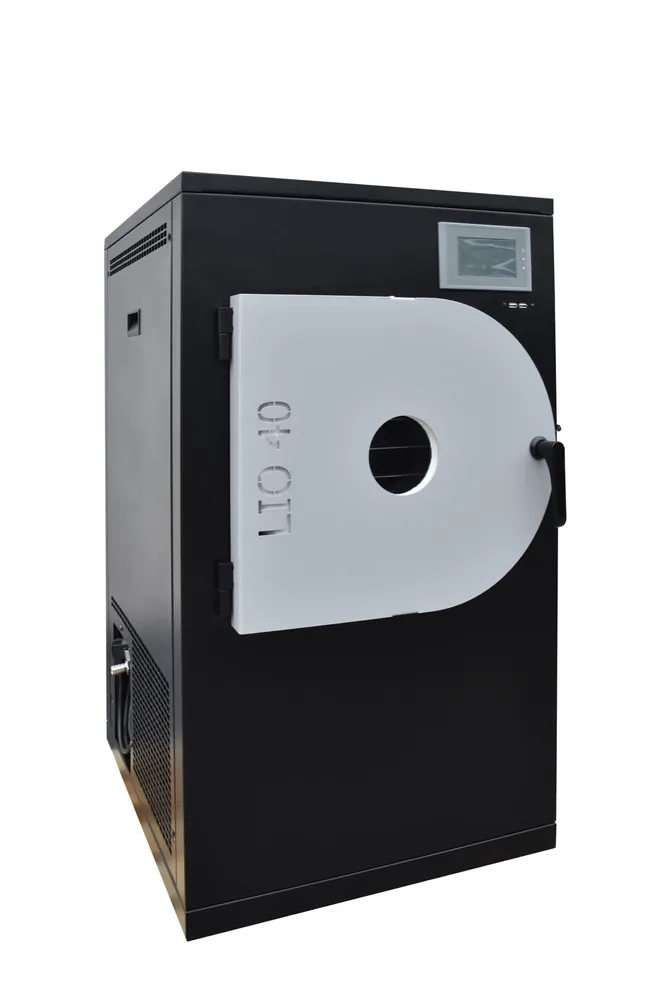
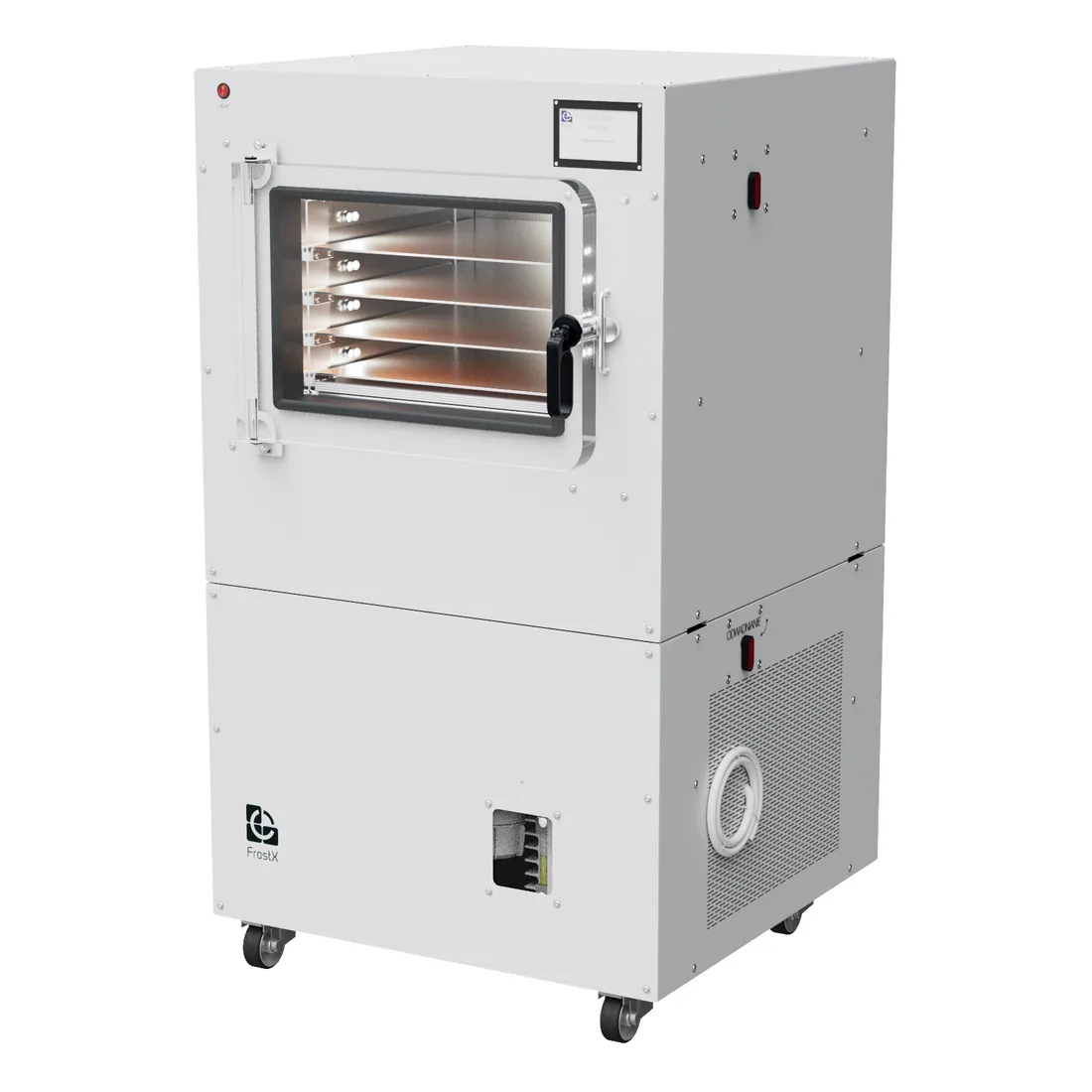
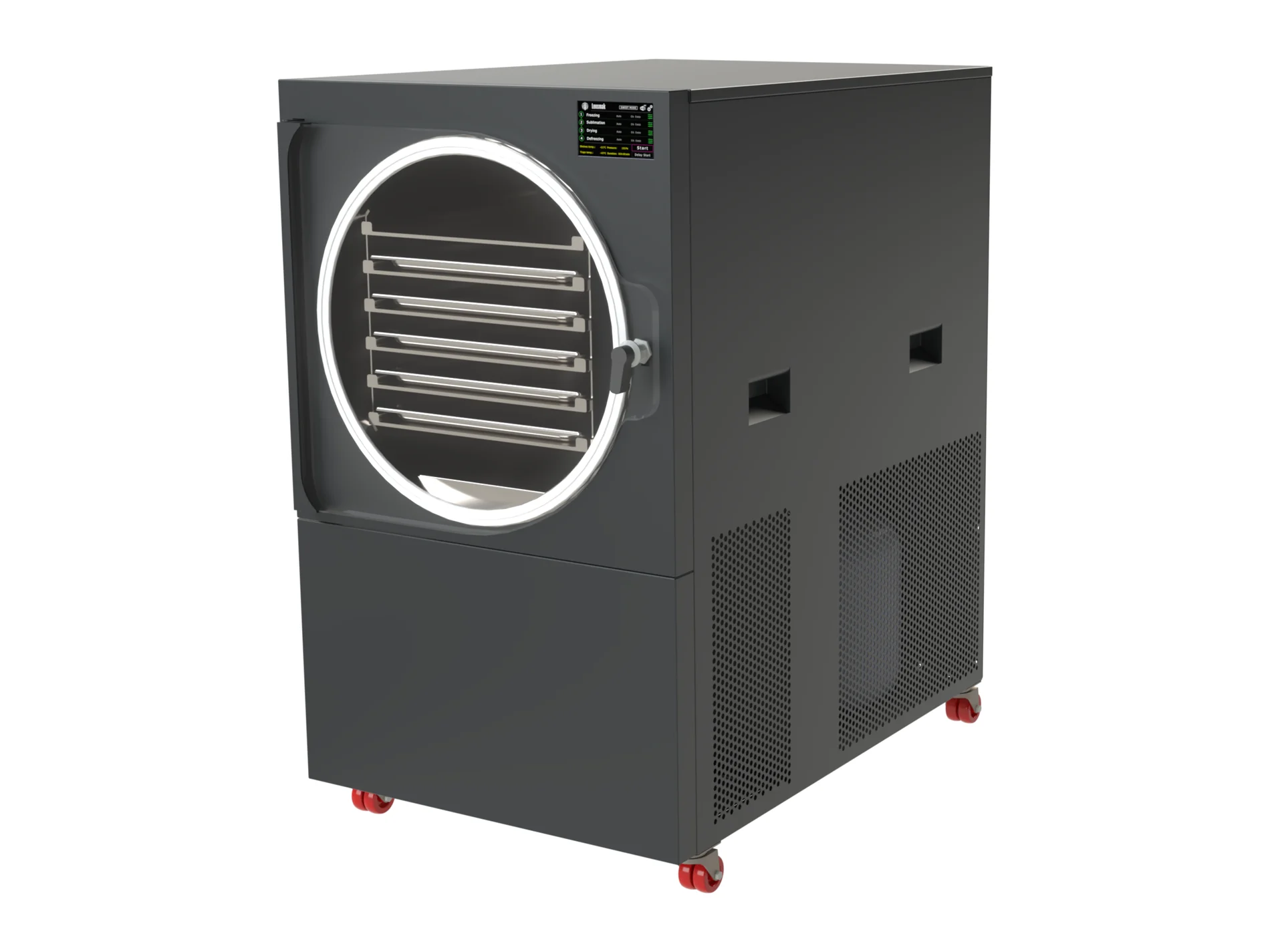
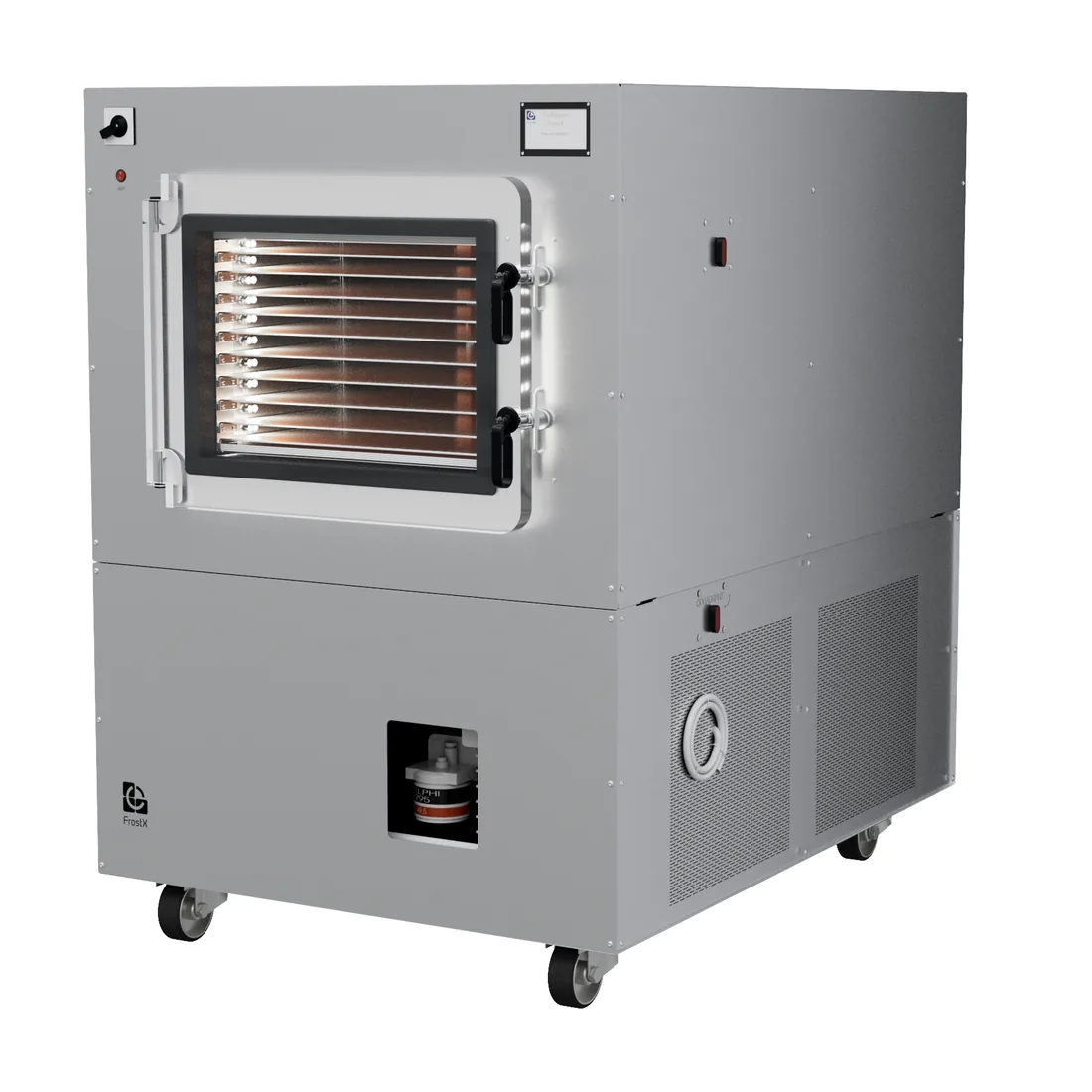
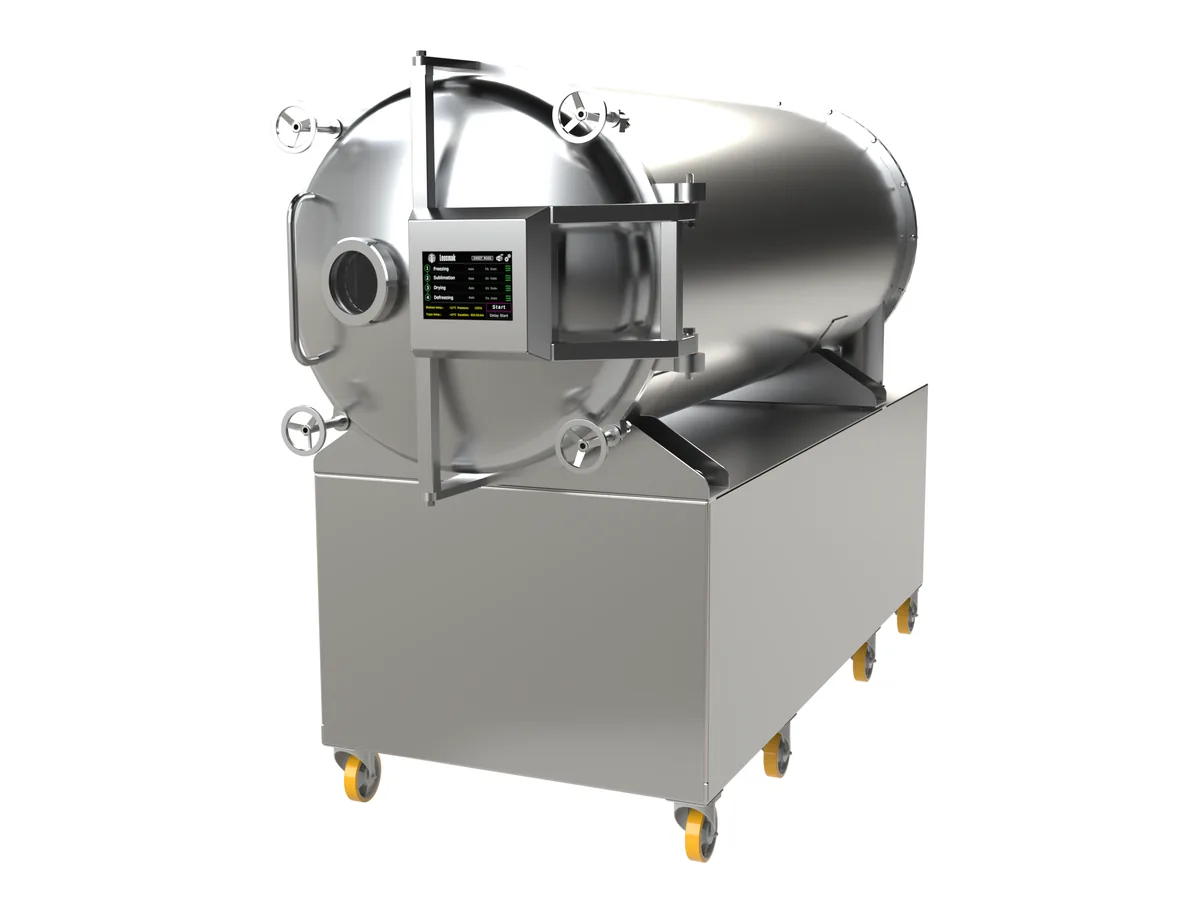
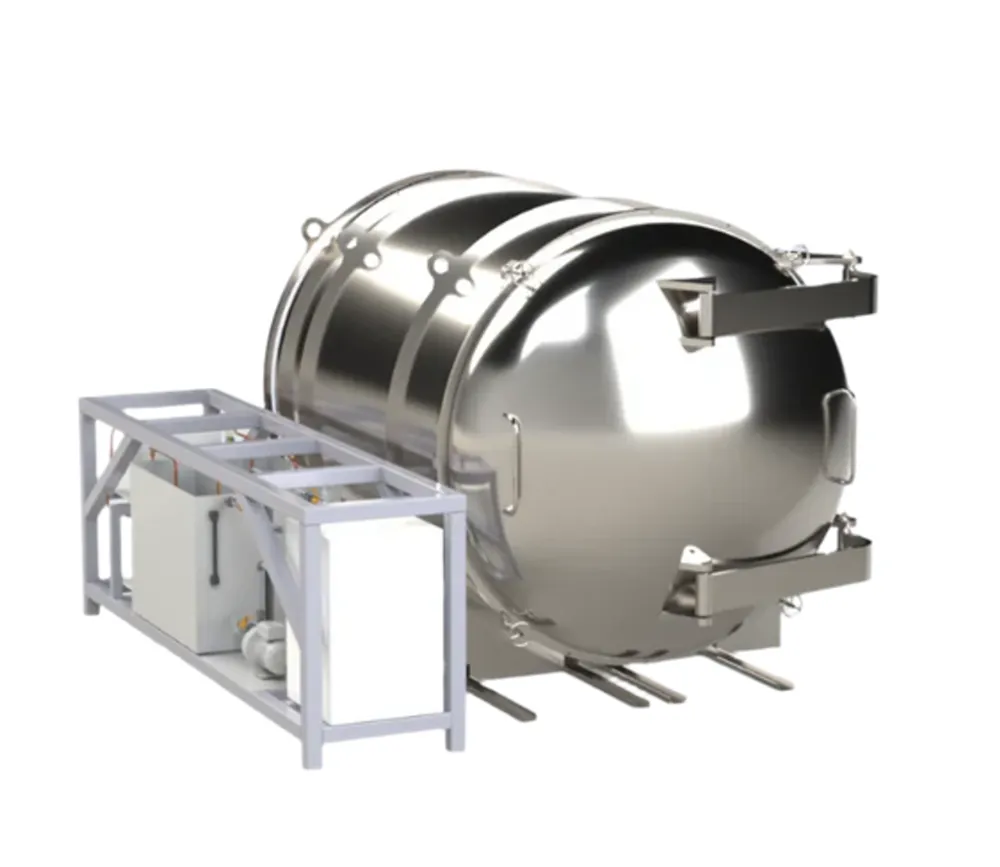
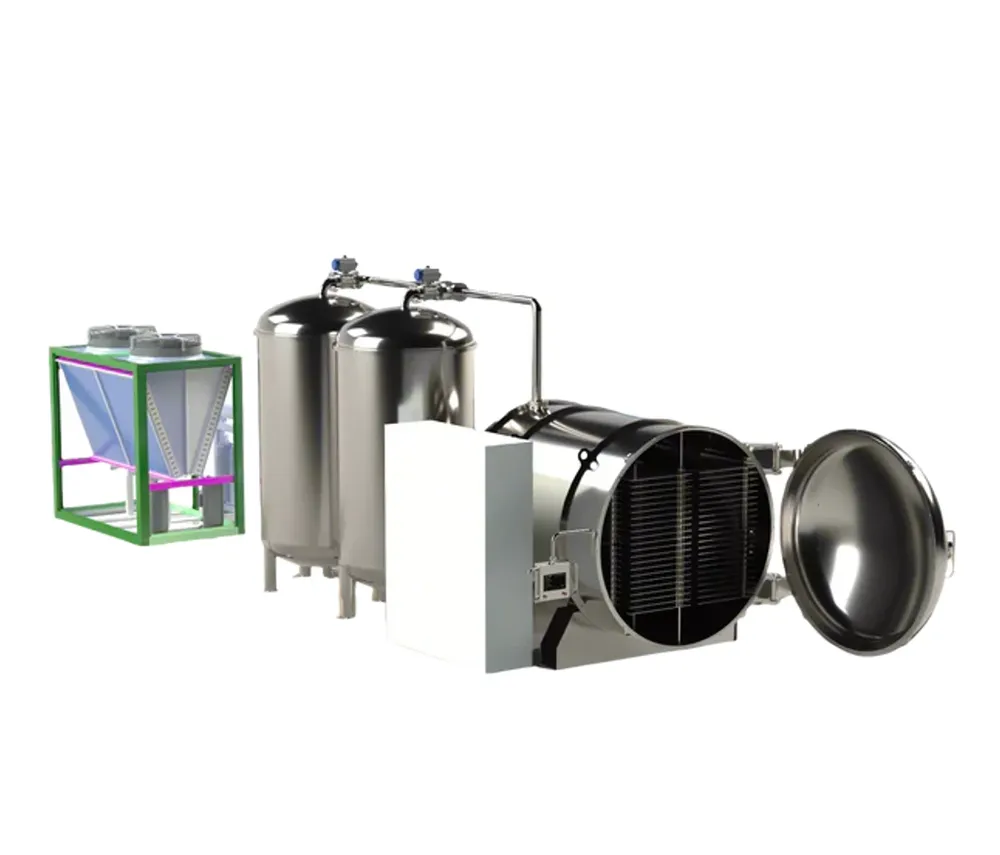
Running cost is average energy consumption across each band. FrostX machines are sold as normal but carry no energy figure until the manufacturer supplies one. Three things to check inside a band, and they are not what the specification leads on. Shelf area is what you are buying, so ask for it rather than reading the rated kilos. Shelf spacing runs roughly 28 to 50 mm across the platforms we sell, and pieces loaded flat can end up touching the shelf above, so ask for the figure on the specific model. A controllable shelf temperature with a low ceiling matters more here than anywhere else, because a coarse heat setting will cost you batches on a low-Tg recipe. Price two routes before you commit: on candy the cheapest way to a given weekly output is often two smaller machines rather than one larger one, because tray area scales with unit count, a sweets cycle turns around inside a working day so you can run both hard, and you keep shipping when one is down.
Yield, and what the input costs
On every other page on this site yield is the bad news: fresh fruit is about 91% water, so you buy eleven kilos to sell one. Confectionery inverts it, and that inversion is what the rest of the arithmetic hangs on.
Two consequences, and they pull in opposite directions. Your material cost per finished kilo is close to what you pay per kilo bought. Bulk unbranded gummies list at €4,14 to €5,46 a kilo in Spanish shops, which puts roughly €5 to €7 of sweet inside a finished kilo before labour, packaging, energy and waste, against our own reference of €140 a kilo typical at retail and €70 B2B. But mass is not what limits your batch. Because pieces sit in a single layer and then expand, tray area binds long before rated capacity does. Water content comes from published gummi and marshmallow formulation ranges; the finished figures assume a 2% residual-moisture target and match the ROI calculator. See the full table, with retail and B2B reference prices
| Input material | Water content | Loaded per 1 kg finished |
|---|---|---|
| Gummies and jellies | ~10–20% | ~1,25 kg |
| Marshmallow | ~17–21% | ~1,2 kg |
| Chews, taffy, caramel | ~6–9% | ~1,05 kg |
| Hard boiled candy | ~1–3% | not a candidate |
| Fresh strawberry, for contrast | ~91% | ~11 kg |
What decides whether this works
Light, crunchy and intensely flavoured is true, and every competitor page says it, so it carries no information. These five decide whether you have a business. One of them is a reason not to buy a machine, and one of them is the reason the machine list on this page is shorter than our catalogue.
Glass transition is a moving target, and the whole cycle is one crossing of it
A sugar matrix behaves like a glass: rigid below its glass transition temperature, soft and flowing above it. The mistake almost everyone makes, including most equipment suppliers, is to assume the rule is to stay below it. That is the rule for freeze-drying a sugary fruit. On a sweet it is the opposite. Wet, a gummy's glass transition sits below room temperature. That is why it is chewy. As water leaves, it climbs toward the values for the dry sugars: roughly 62 to 70 °C for sucrose, 31 to 39 °C for glucose, 5 to 14 °C for fructose, and a real recipe lands somewhere between its components. The cycle deliberately holds the piece above that line so the matrix turns rubbery and can inflate, then lands it below the risen line, still under vacuum, so the expanded foam sets as a glass. That single crossing explains everything else on this page. Run a gummy cool and slow and it never crosses upward: you get a shrunken, dense, chewy piece instead of a puffed one. Cut the cooling stage short and the foam collapses on its way out of the chamber. A fructose-heavy chew has a glass transition near room temperature even when dry, so it never sets and stays tacky no matter what machine you buy. Hard candy has too little water to inflate at all. And a finished piece that picks up moisture on the bench is being plasticised back below the line: hygroscopic failure is the drying step running backwards.
Trays fill by volume, and the pieces get bigger as they dry
Every capacity on this site is quoted as fresh load by mass, because on fruit, meat and vegetables mass is what binds. On candy it does not. Pieces have to sit in a single layer with clearance, and inflation is the point of the process, so the load occupies more tray area at the end of the cycle than at the start. You reach the edge of the tray long before you reach the rated kilos. A machine rated up to 30 kg of wet load will not take 30 kg of gummy bears in any useful arrangement. Producers and vendors describe expansion of two to four times the original volume; we have found no measurement we can stand behind, so we publish none. Plan the batch from a loaded tray, not from the specification.
The finished product is hygroscopic, and that is where most entrants fail
A correctly dried piece sits near 1 to 2% residual moisture and will pull water out of ordinary room air fast enough to go soft on the bench. The control point is the time between opening the chamber and sealing the pouch, and the humidity of the room where that happens. Barrier film, a desiccant where the format allows one, and a sealer ready before the cycle ends. None of that is a machine specification and no spec sheet mentions it. Budget for a dry packing area before you budget for a bigger dryer. It is the same physics as the drying stage, running in reverse: water going back in drops the glass transition below room temperature and the structure you paid for softens.
Not every freeze-dryer can run this cycle
This is the only category we serve where the machine list is shorter than our catalogue, and it is worth understanding why before you shop on price. A sweets cycle needs three things. It has to be able to skip the freezing stage, because forcing a freeze on a sweet wastes three to four hours and achieves nothing, because there is no freezable water to turn into ice. It has to hold a shelf setpoint around 50 to 55 °C, which is well above what a machine designed only for fruit ever needs. And it has to cool the shelf back down while the chamber is still under vacuum, because that is the step that sets the structure; without it the piece slumps as soon as you break vacuum. Plenty of freeze-dryers on the market meet one or two of those and not the third. A machine that only offers slight heating of the shelves, with no setpoint you can dial, cannot run this process at all, and a supplier who sells you one anyway will tell you it was your recipe. Every machine listed on this page meets all three conditions and we have confirmed it with the manufacturer. That is why some of the models in our own catalogue are not here.
Re-processing someone else's branded sweet carries a trade mark exposure
A large share of entrants buy branded retail sweets, dry them and resell them under the original name. Two rules bite. Article 15(2) of Regulation (EU) 2017/1001 lets a trade mark owner oppose further commercialisation where the condition of the goods has been changed or impaired after they were put on the market, and freeze-drying changes it materially; shape and colour may separately be protected. And the moment you process and repack, you are the food business operator responsible for that food under Regulation (EC) No 178/2002 and for the food information under Article 8 of Regulation (EU) No 1169/2011. If that is the whole plan, do not buy a machine. Buy unbranded bulk or make your own, and the problem disappears.
What applies before you sell
This is the shortest regulatory route of any category we serve, and we say so plainly. Confectionery is food of non-animal origin, so there is no establishment approval to wait for and no pre-production inspection to pass. Three places are where freeze-dried sweets specifically go wrong, and two of them are on the label. Orientation from an equipment supplier, not legal advice.
Registration and HACCP, not approval
Article 6 of Regulation (EC) No 852/2004 requires you to notify your competent authority of the establishment, for registration. Article 5 requires procedures based on HACCP principles, with the general hygiene requirements in Annex II covering premises, water, waste, pest control and personal hygiene. In this category the failure mode is moisture pick-up rather than microbial growth, so your release record is water activity measured per batch on a bench meter you own. Budget for the meter: no equipment supplier can produce that figure for you.
The nutrition declaration is not the one on the bag you bought
Under Article 31(3) of Regulation (EU) No 1169/2011 the nutrition declaration is expressed per 100 g of the food as sold. Removing 10 to 20% of the mass as water concentrates everything that remains, so sugar and energy per 100 g both rise and the figures printed on your input packaging are no longer yours to copy. Net quantity changes too. The full ingredient list and the fourteen allergens in Annex II are yours to declare, including additives carried over from the input sweet under Regulation (EC) No 1333/2008. Any voluntary front-of-pack scheme reads the same concentrated numbers, so a recipe that scored one way wet will score worse dry.
Durability, storage and the claims you make
You set the date of minimum durability and the storage conditions, and you have to be able to justify them. Here the evidence is packaging performance and water-activity data rather than a shelf-life microbiology panel alone. Health and nutrition claims under Regulation (EC) No 1924/2006 need substantiation, and on a high-sugar product they are indefensible. We make none, including the fewer-preservatives argument competitors reach for: it is not supportable and we do not use it.
Where to file
Register with the health authority of your Comunidad Autónoma, which enters the establishment in the Registro General Sanitario de Empresas Alimentarias y Alimentos under Real Decreto 191/2011. The register is national and unified: AESAN maintains it and publishes the public consultation database, and the autonomous community processes you. Expect an inspection of the premises as part of it.
The mera comunicação prévia is filed through the Balcão do Empreendedor before you start trading, which satisfies the Article 6 registration duty. ASAE enforces food safety and economic compliance, and publishes guidance on starting a food business and on proportionate HACCP for small operators.
Orientation, not legal advice. Confirm your own case with your competent authority before you invest, and take the trade mark question to a lawyer rather than to us. Checked against consolidated EU texts and national sources in August 2026.
What you can produce
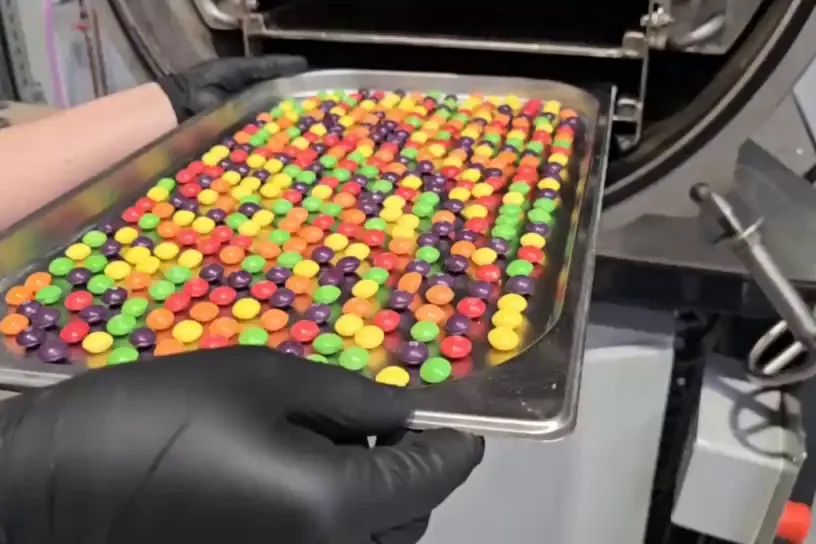
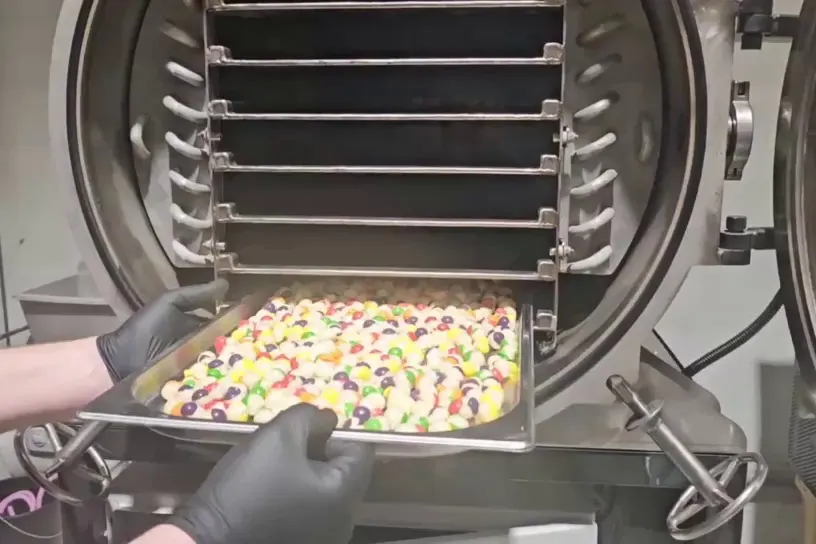
An established Spanish confectioner, bringing development in house
In March 2026 a well-known Spanish confectionery manufacturer bought a compact-commercial machine from us, with the application recorded simply as sweets.
For an established manufacturer that buys development capacity rather than production capacity: the ability to trial freeze-dried lines on their own premises, on their own recipes, without sending product out and waiting weeks for somebody else's chamber. The compact tier is the right tool for that and the wrong tool for filling retail orders, which is the distinction most first-time buyers get backwards. We are not publishing the name, the volumes or the machine model, because we have not asked.
Replacing a hobby unit, the most common purchase in this category
An operating profile rather than a customer, built from live catalogue prices and the yield and retail figures on this page. The pattern is consistent: a brand starts on a domestic freeze-dryer, sells out at markets and on social commerce, then hits a wall that is not demand. The hobby unit runs one small tray set, so weekly output is capped no matter how many orders arrive.
The step that resolves it is compact or light commercial, €4.950 to €8.950 ex-VAT, chosen on shelf area rather than headline capacity, plus a dry packing area and barrier film. Material cost per finished kilo barely moves. What changes is that a week's orders fit inside a week's batches. The common mistake at this step is buying on rated kilos, and on candy rated kilos are the wrong number.
Frequently asked questions
How much freeze-dried candy do I get from a kilo of sweets?
Roughly 0,8 kg of finished product from a kilo of gummies loaded, about 0,83 kg from marshmallow and about 0,95 kg from chews and taffy, drying to a 2% residual-moisture target. These are the same figures behind our ROI calculator. For comparison, a kilo of fresh strawberries gives you about 90 grams. That inversion is the reason the economics of this category look the way they do.
Is freeze-dried candy actually freeze-dried?
Not in the strict sense, and we would rather tell you than have you find out. A gummy holds 10 to 20% water bound into a sugar matrix, and almost none of it is freezable: freeze it and you get no ice to sublime. What the machine runs on sweets is a dedicated cycle with no freezing stage: warm the piece above its glass transition, pull vacuum so the water inside flashes to vapour and inflates it, then cool it under vacuum so the expanded structure sets as a glass. The trade calls the result freeze-dried candy and so do we, because that is the name it sells under, but the process is expansion under vacuum. It is why a sweets cycle takes hours rather than a day.
Then do I need a freeze-dryer, or would a vacuum oven do?
You need a freeze-dryer, for three reasons a vacuum oven does not cover. A shelf that both heats and cools under vacuum, which is the step that sets the structure and the one a vacuum oven has no way to perform. A cold trap, without which the water vapour goes straight into your vacuum pump and destroys the oil. And closed-loop pressure control, because how fast you drop the pressure is what sets how much the piece expands. You also need the machine for fruit inclusions, which is real freeze-drying and where a good part of the durable revenue in this category sits.
Why does freeze-dried candy sell for so much more than the sweets it is made from?
Because almost none of the mass is lost and the format is new. Bulk unbranded gummies list at €4,14 to €5,46 a kilo in Spanish shops, so roughly €6 of sweet sits inside a finished kilo, while our own price reference puts freeze-dried gummies at €140 a kilo typical at retail and €70 as a B2B reference. Whether that gap survives as the category matures is a commercial judgement rather than a fact, and it is a reason to buy for today's volume rather than for a forecast.
How long is a cycle?
Hours, not the day or more a wet fruit crop needs, because there is very little water to remove and no ice to sublime. On a machine running its sweets programme, manufacturers' own reference cycles use a drying stage of one and a half to three hours; allow four to eight hours door to door once warm-up, cooling, loading and unloading are counted. That is what makes the compact tier viable as a production machine rather than just a development one: a batch turns around inside a working day. Two conditions attach. It only holds on the sweets cycle: put the same sweet through a standard freeze-drying programme and it will force-freeze first and run far longer for a worse result, which is why the machine list on this page is narrower than our catalogue. And the exact figure depends on the recipe and the load, so we measure it on your product rather than quoting one.
Which sweets do not work?
Hard boiled candy, because at 1 to 3% water there is almost nothing to vaporise and far too little moisture in the matrix for it to expand. Chocolate as a primary product, because fat does not evaporate and you risk bloom and meltback at the shelf temperatures this process needs, so chocolate belongs on the outside and goes on after drying. Very high-invert chews and some caramels stay tacky or slump, because their glass transition temperature sits near room temperature even when dry, so the structure never sets. That last one is a recipe limit, not a machine fault, and no equipment will fix it. We would rather tell you before you order than after.
What is glass transition temperature and why does it matter?
A sugar matrix behaves like a glass: rigid below a certain temperature, soft and flowing above it. The important part is that the temperature moves. Wet, your sweet's glass transition is below room temperature, which is why it is chewy. As water leaves during the cycle it climbs toward the dry-sugar values, roughly 62 to 70 °C for sucrose, 31 to 39 °C for glucose and 5 to 14 °C for fructose, with a real recipe somewhere between its components. The cycle holds the piece above that line to expand it and lands it below the risen line to set it. That figure, not the machine, decides your shelf temperature, your cycle length and whether the piece sets hard or stays tacky.
Can I buy a branded sweet, freeze-dry it and sell it?
Buying unbranded bulk confectionery and selling under your own name is straightforward. Reselling a branded sweet under its original name after freeze-drying is not. Article 15(2) of Regulation (EU) 2017/1001 lets a trade mark owner oppose further commercialisation where the condition of the goods has been changed after they were put on the market, and freeze-drying changes it materially. Shape and colour may separately be protected. Separately, once you process and repack you become the food business operator responsible for the product and its labelling under Regulation (EC) No 178/2002 and Regulation (EU) No 1169/2011. Take advice. Most of the durable brands in this category buy unbranded bulk or make their own.
Does the label change after freeze-drying?
Yes, and it is the most commonly missed step. The nutrition declaration is per 100 g of the food as sold under Article 31(3) of Regulation (EU) No 1169/2011, so removing water raises sugar and energy per 100 g. Net quantity changes. The full ingredient list and the fourteen allergens in Annex II are yours to declare, including additives carried over from the input sweet. Any voluntary front-of-pack scheme is recalculated on the concentrated figures too.
How do I stop the finished sweets going soft?
Control the time and the humidity between the chamber and the seal. At roughly 1 to 2% residual moisture the product pulls water out of ordinary room air within minutes. Barrier film, a sealer ready before the cycle finishes, and a packing area that is dry. This costs far less than a bigger machine and fixes more first-batch failures than any specification does.
What does a commercial freeze-dryer cost, and what does it cost to run?
Compact commercial from €4.950, light commercial from €8.950, commercial from €13.950 and industrial from €145.480, all ex-VAT list, across three manufacturers. Energy runs about 0,9 to 1,4 kWh per hour in the compact band and 4 to 13 kWh per hour at industrial scale. On candy electricity is a minor line: tray area and packing discipline decide your cost per kilo.
Should I buy the biggest machine I can afford?
No. On candy, capacity is limited by tray area and by how the pieces expand rather than by rated kilos, so a larger chamber does not convert into output the way the specification implies. Two smaller machines often deliver more weekly output than one larger one for the same money, at the cost of floor space and maintenance. And if your volume rests on one novelty line, buy a tier below the forecast.
Send us your sweet and your weekly volume.
Tell us what you want to dry, how much per week, and where you are. We will size it against the live catalogue, run the cost per finished kilo against our published prices, and tell you plainly if freeze-drying is the wrong answer, which for hard candy and for chocolate it usually is.
Two other times we will tell you not to buy yet. If your volume rests on a single novelty line, buy one tier below what the forecast says: novelty demand decays, and a machine bought against a peak week sits idle for the rest of the year. If that worries you, ask us about fruit inclusions before you ask us about gummies: same machine, B2B customers, and demand that does not depend on the format staying fashionable. And if the plan is to freeze-dry branded retail sweets and sell them under the original brand's name, do not buy at all. More capacity only enlarges the exposure.