
Freeze-Dryers for Meat & Seafood
Ambient-stable protein at a fraction of the shipping weight, with an honest account of what the fat, the microbiology and Regulation (EC) 853/2004 will ask of you.
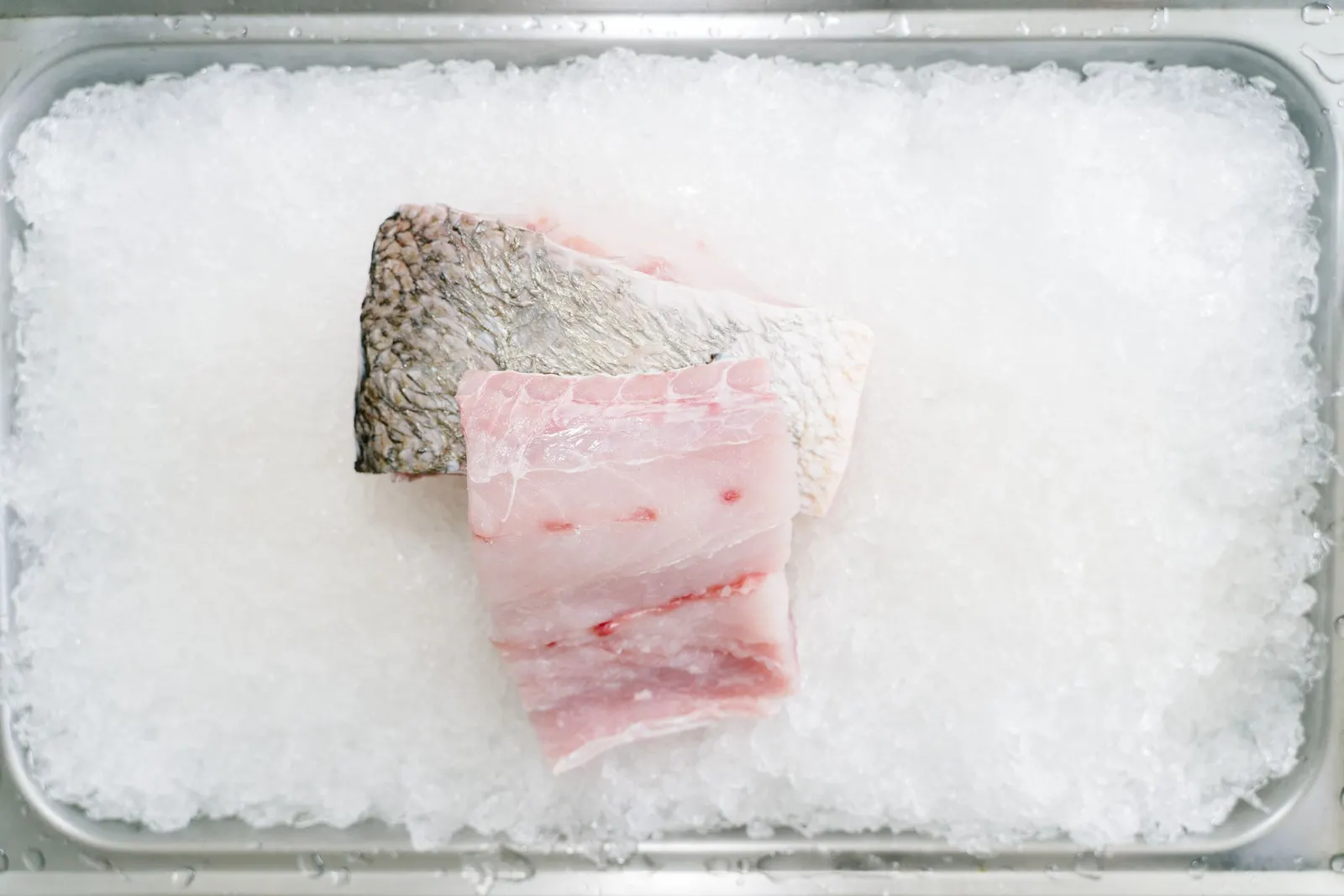
Meat and fish are the most valuable and the most perishable things a food producer handles. Removing 95 to 98% of the water takes the cold chain out of the product and most of the weight out of the shipment. That is why freeze-dried protein sits inside almost every expedition ration sold in Europe.
It is also the hardest category in this catalogue to run well. Fat does not sublimate. Freeze-drying stops microbial growth but does not sterilise. And products of animal origin need an approved establishment before you sell a gram: approval, following an on-site visit, not a registration.
This page covers the yields, the machine costs, the three markets worth serving, and the constraints that decide whether your product works. Including the ones that should stop you buying.
In short
Send us 2 kg. Get measured yield and cycle figures.
Everything on this page is calculated from published data. Your material is not published data. Send us 2 kg of the product you actually intend to sell: the cut you buy, cooked the way you would cook it, at the piece size you plan to run.
You get back measured yield, a realistic cycle plan for your material, and a machine recommendation across all four manufacturers. If freeze-drying is the wrong process for your product, that is what we will tell you.
Which freeze-dryer for your scale
Capacity is fresh load per batch, meaning what goes in wet rather than what comes out dry. Prices are ex-VAT list prices, pulled live from the catalogue.
| Stage | Fresh load per batch | Running cost | From | Representative models |
|---|---|---|---|---|
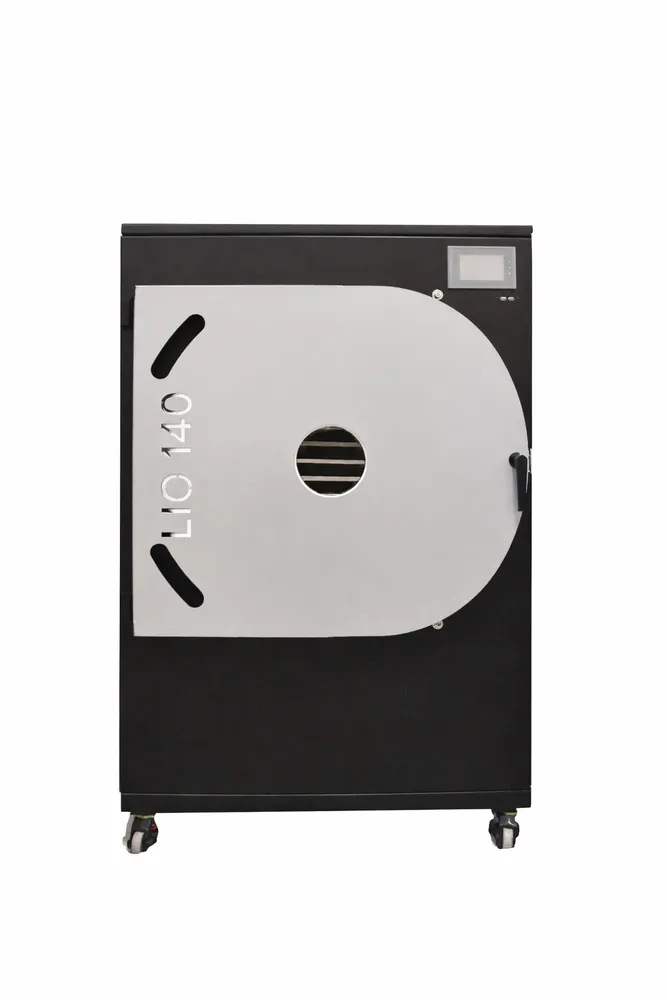
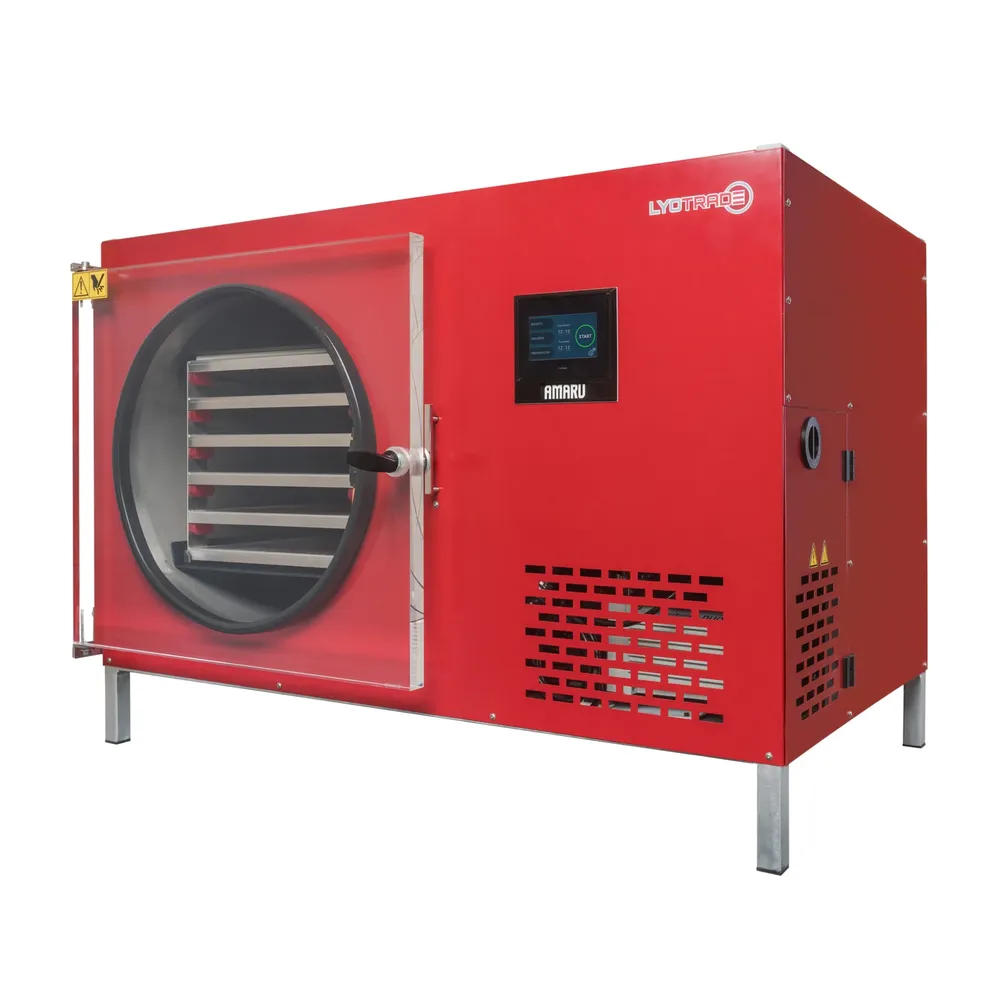
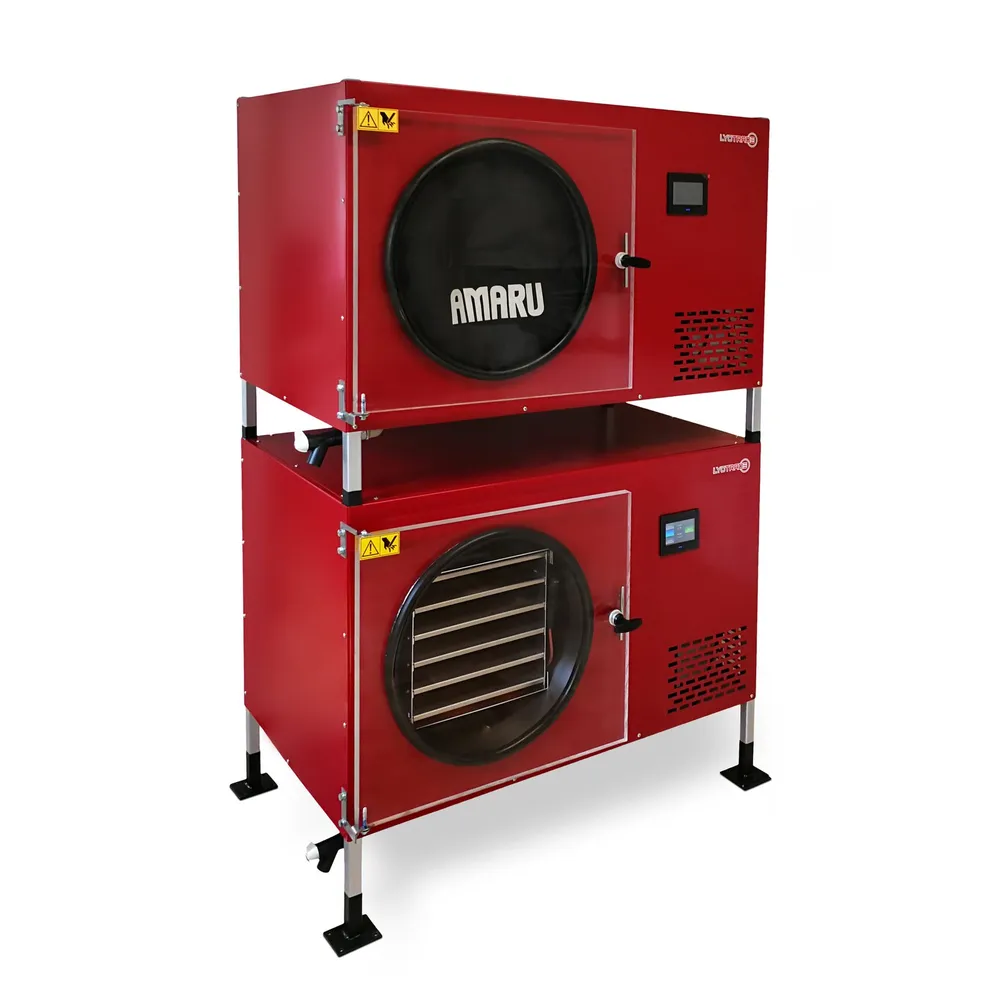
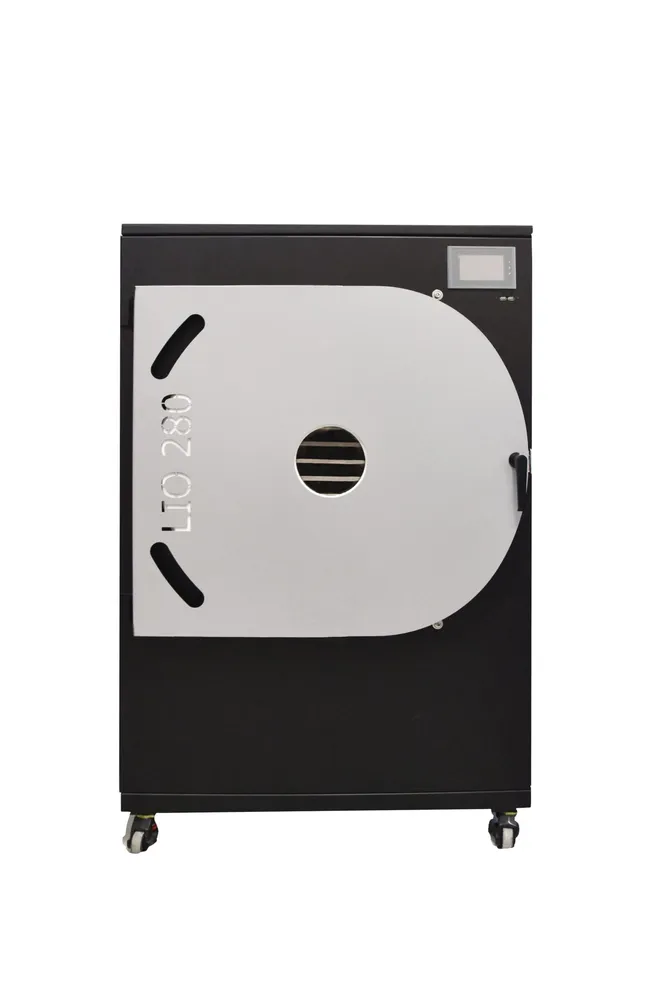
| Compact commercialR&D, first product, single-material snack line | Up to 10 kg | 0,9–1,4 kWh/h | €4.950 | |
| Light commercialfirst real production line | Up to 18 kg | 1,13–2,46 kWh/h | €8.950 | |
| Commercialestablished production, multi-SKU | Up to 50 kg | 2,25–3,59 kWh/h | €13.950 | |
| Industrialprocessor scale, trim valorisation, contract drying | Up to 600 kg | 4–13 kWh/h | €145.480 |
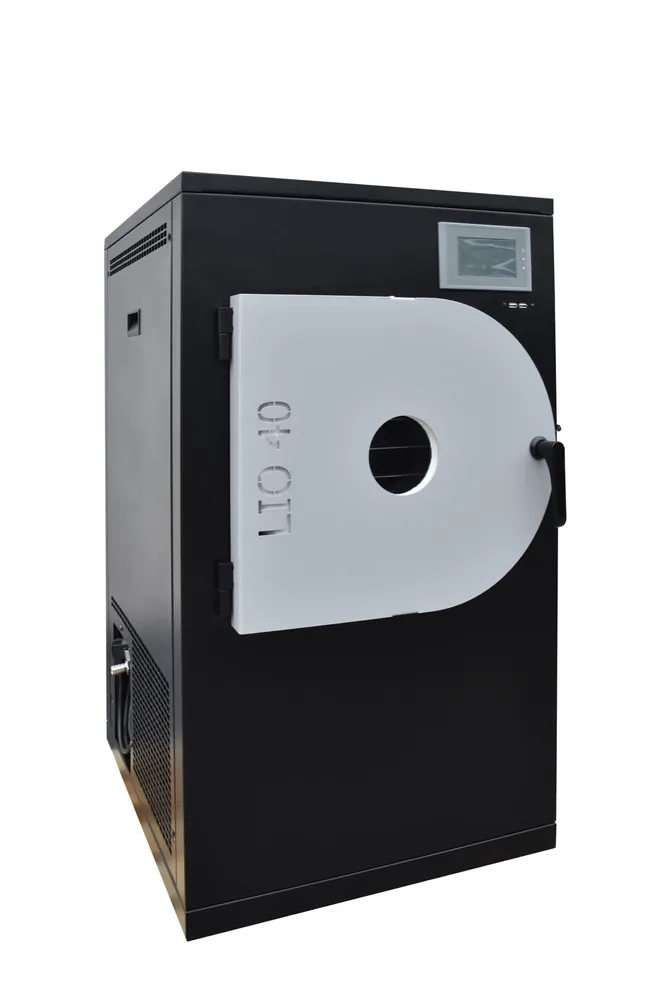
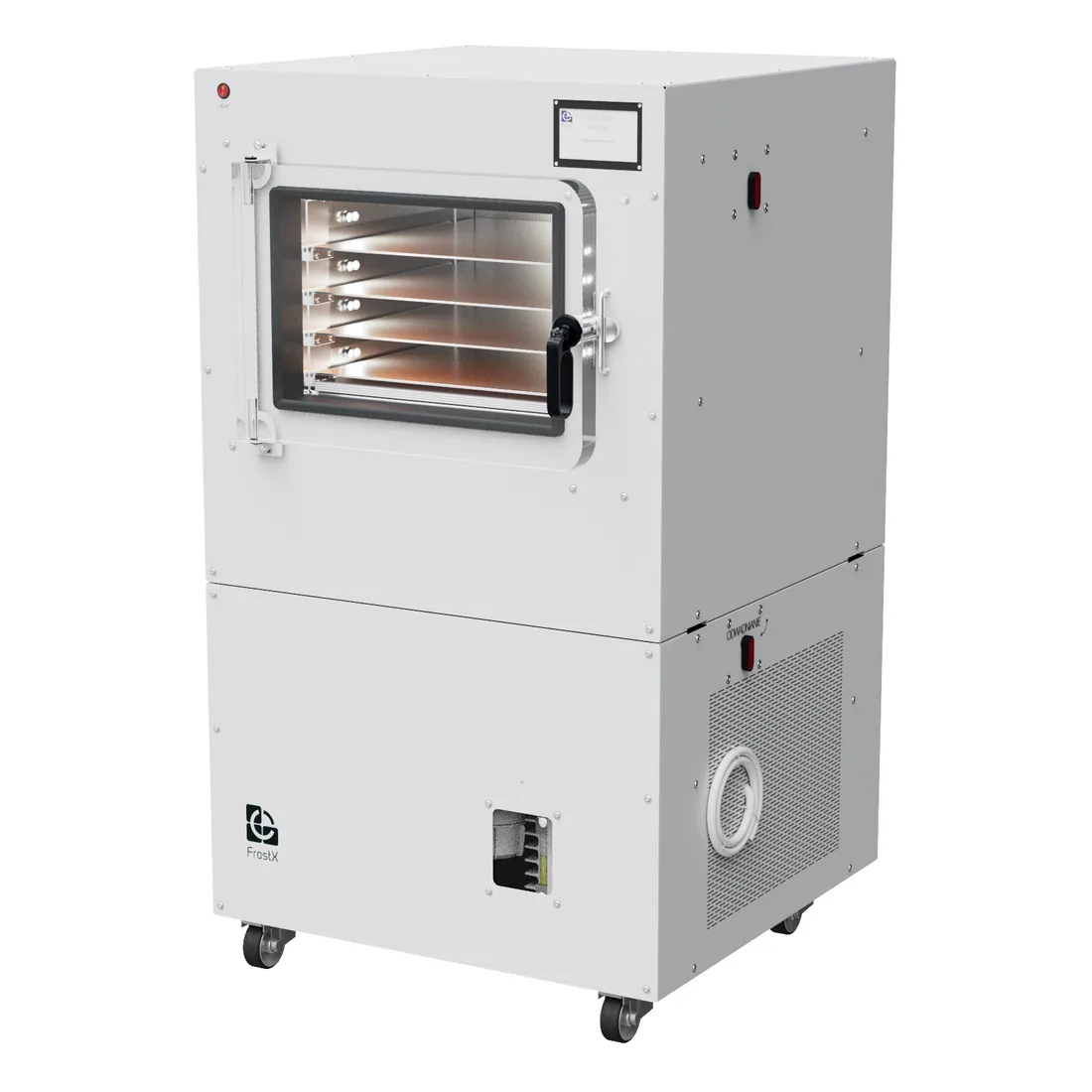
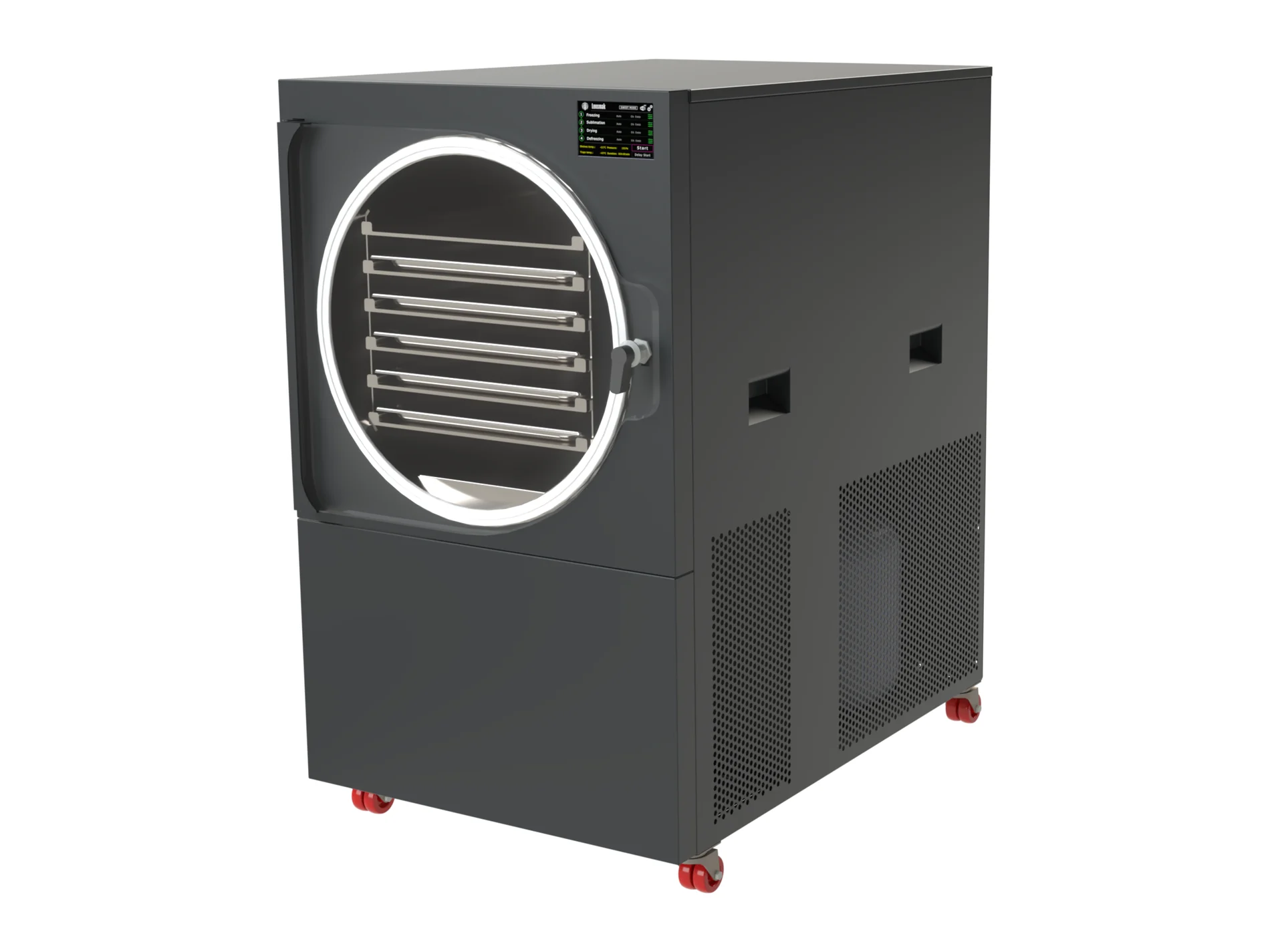
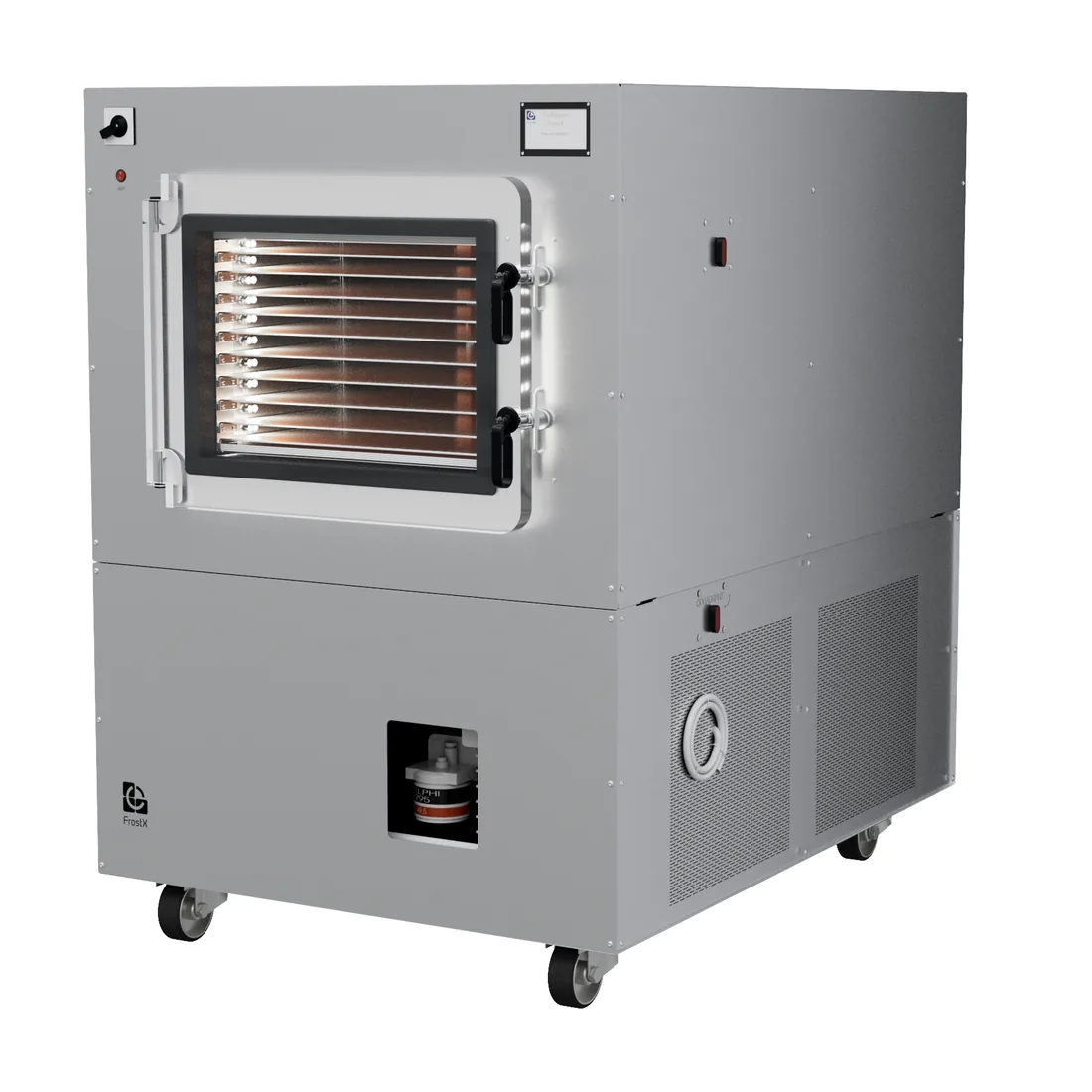
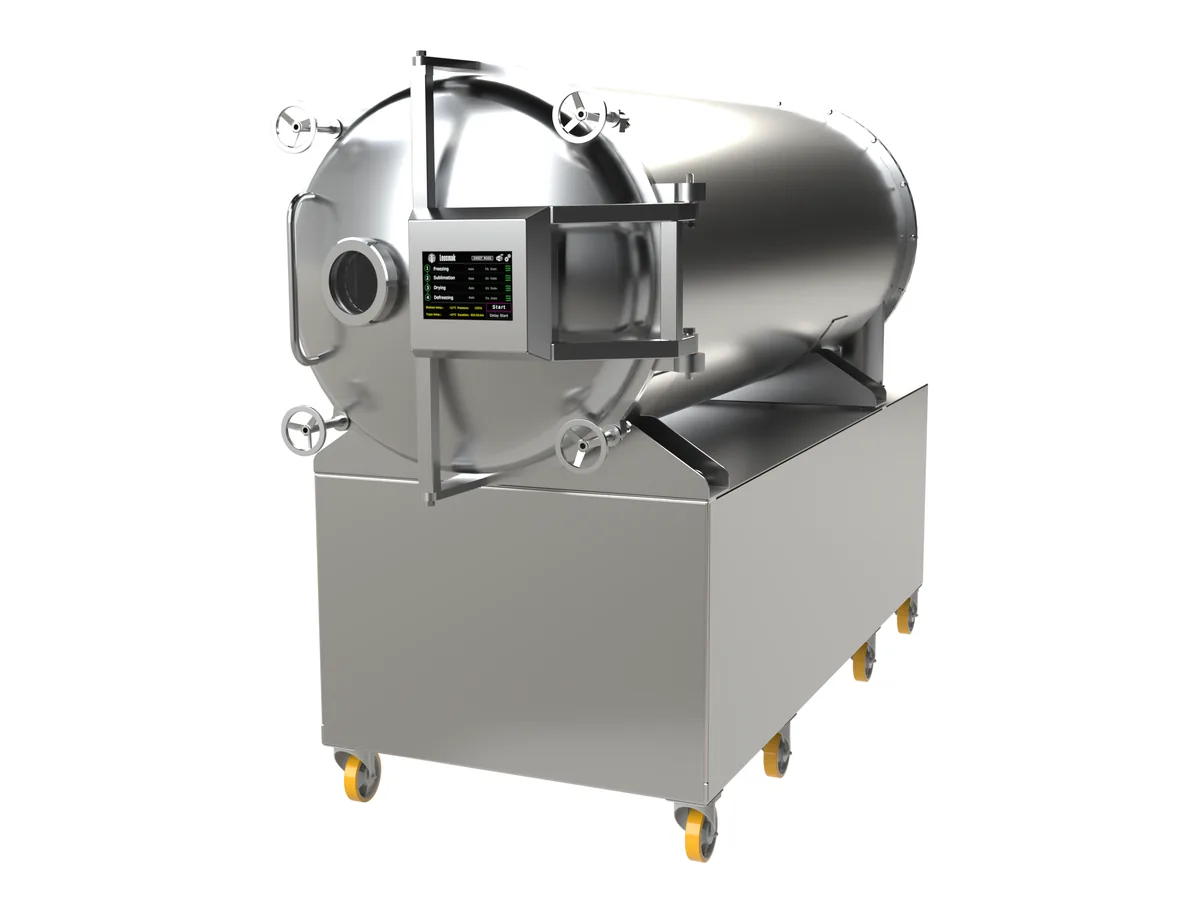
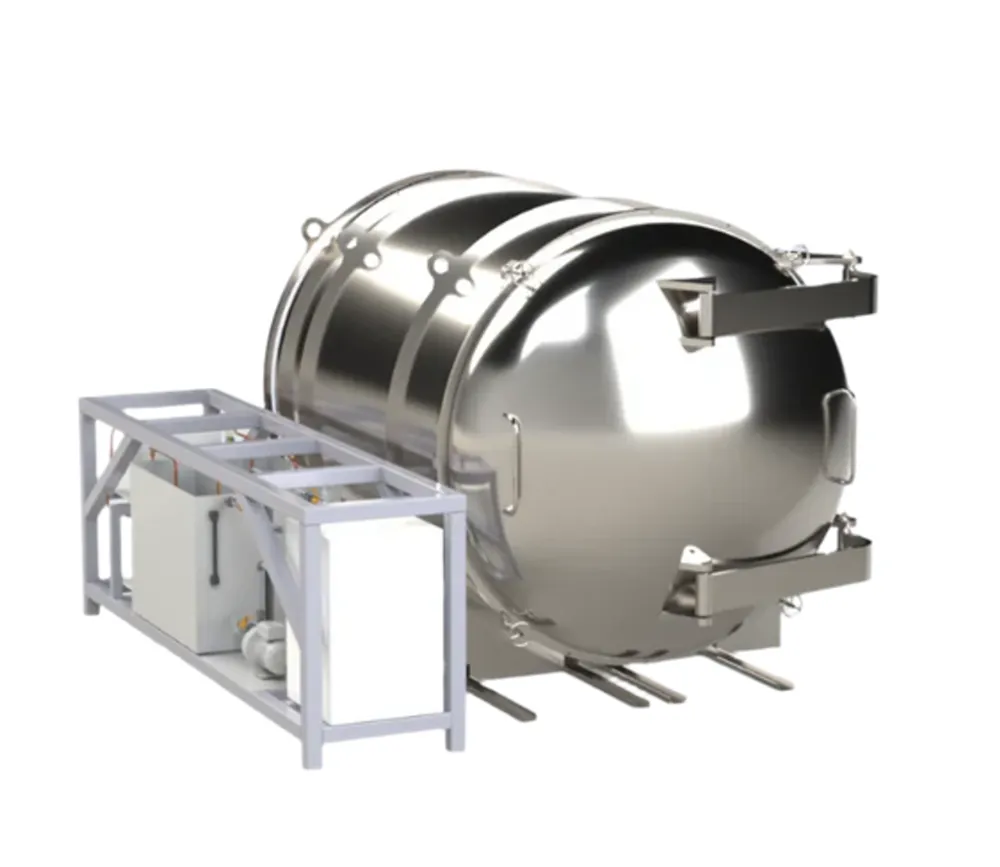
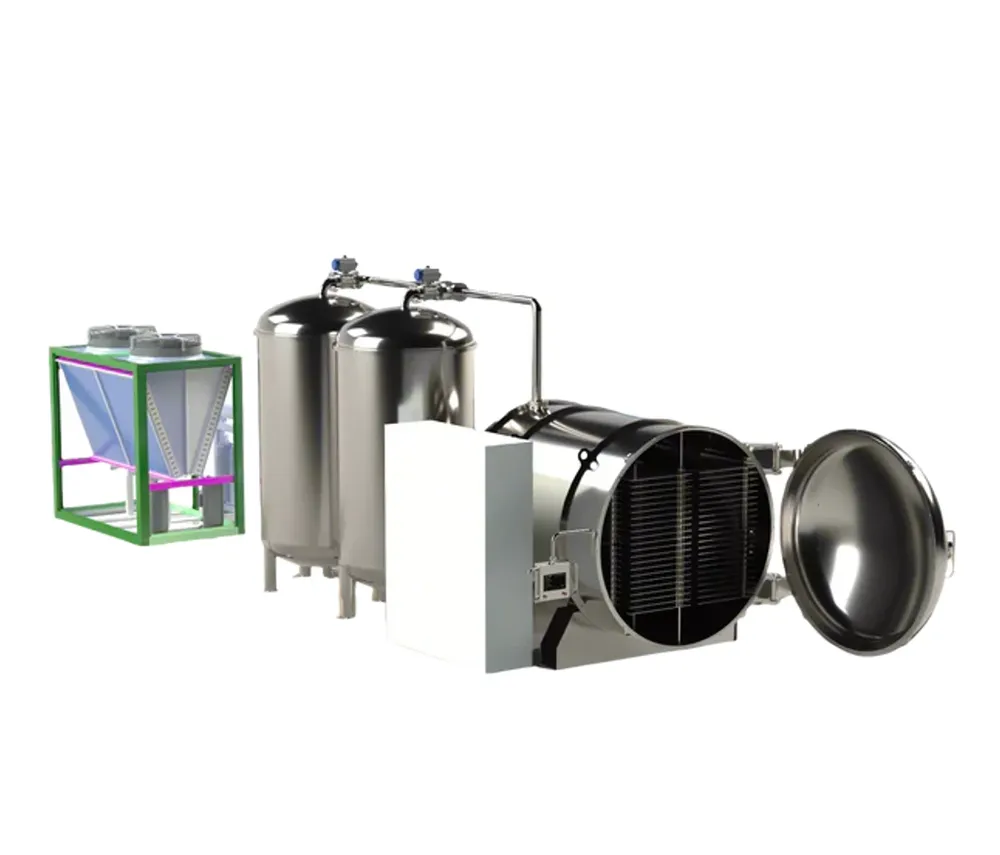
Running cost is average energy consumption across each band. FrostX machines are sold as normal but carry no energy figure until the manufacturer supplies one. Three things to check inside a band. Condenser capacity, not shelf area, is what limits you on seafood, so ask for the ice-condenser figure and size against the wetter material. Upstream freezer capacity is part of the purchase, and fish for raw consumption carries a legal freezing step at −20 °C or −35 °C. Oil-free scroll pumps drop the oil-change routine but cost more up front.
Yield: the number to plan around
Freeze-drying removes water. Your input is mostly water and your output is not, and machine capacity is quoted as fresh load per batch, so the ratio below is what turns a machine specification into a business plan. Figures are for raw material from USDA FoodData Central.
Cooked material is different. Roasted chicken breast falls to about 65% water (~2,9 kg per finished kilo), cooked cod to about 76% (~4,1 kg), but you lose that weight in the cook instead, so plan from cooked weight. A machine rated up to 30 kg fresh load returns roughly 6 to 11 kg finished per cycle across this range, and very wet material such as cod, mussel and squid ties up chamber time for little output. The best-looking yields belong to the fattiest species: salmon returns most per batch and is hardest to keep on a shelf.
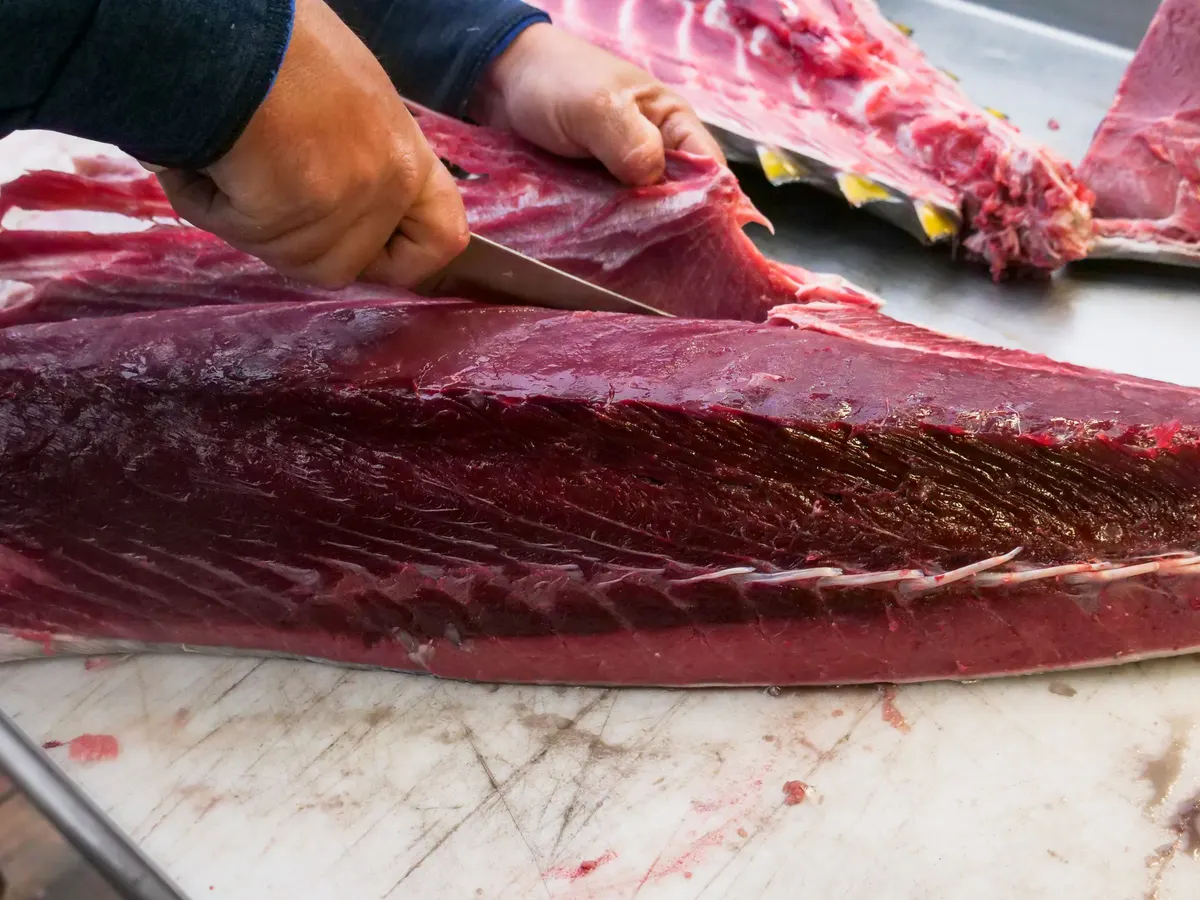
| Raw material | Water | Fat | Fresh input per 1 kg finished |
|---|---|---|---|
| Salmon, Atlantic, farmed | ~64,9% | ~13,4% | ~2,8 kg |
| Beef, lean (top round) | ~71,4% | ~4,8% | ~3,5 kg |
| Pork loin, lean | ~72,2% | — | ~3,6 kg |
| Chicken breast, skinless | ~73,9% | ~2,6% | ~3,8 kg |
| Tuna, yellowfin | ~74,0% | — | ~3,8 kg |
| Prawn / shrimp | ~78,4% | — | ~4,6 kg |
| Squid | ~78,6% | — | ~4,7 kg |
| Mussel, blue | ~80,6% | — | ~5,2 kg |
| Cod, Atlantic | ~81,2% | ~0,7% | ~5,3 kg |
What decides whether this works
Most equipment pages list benefits. These four constraints set your cost per kilo and your shelf life. Two of them are reasons not to buy.
Freeze-drying is not a kill step
It preserves what is in the product, good and bad. Lyophilisation is how culture collections keep pathogens alive for decades: the UK Health Security Agency reports freeze-dried Enterobacteriaceae viable after more than 50 years. One published study of drying alone recorded at most 1,53 log reduction for Salmonella and 2,03 for Listeria monocytogenes, far short of a validated kill step. Your safety system is sourcing, hygiene, any heat step before drying, and water activity.
Water activity is the control. Moisture percentage is not
Microorganisms respond to available water. Published growth minima are specific: Salmonella aW 0,94, Listeria monocytogenes 0,92, Staphylococcus aureus 0,83, proteolytic Clostridium botulinum 0,935. Below those the organism stops multiplying but does not die, and Salmonella survives long periods in low-moisture food and regrows on rehydration. Release each batch on a bench water activity meter, not a weight-loss figure.
Fat does not sublimate, and it fails first
Sublimation removes ice and leaves fat behind, so it concentrates. Farmed Atlantic salmon at about 65% water and 13% fat becomes roughly 38% fat dried; cod becomes about 4%. The porous structure gives oxygen access to all of it: one published comparison put freeze-dried meat at a peroxide value of 83,3 mEq/kg against 20,8 for air-dried. Fatty cuts also case-harden, a dry crust over a moist core that passes a weight check and fails on water activity. Lean beef, chicken breast, pork loin, cod, hake, prawn, mussel and squid behave; salmon, mackerel, sardine and skin-on cuts are hard. Barrier packaging belongs in your per-kilo cost from day one.
For some fatty products this is the wrong process
Oily fish sold at volume into a price-sensitive channel rarely works. You pay for a long cycle on material whose yield flatters you, pay again for barrier packaging and inert-gas flushing, and still carry a shorter shelf life than a lean product. Published work on freeze-dried mackerel and sardine found autoxidation fastest in the first three months. Smoking, canning or selling frozen may serve you better, as it may if the customer cooks the product anyway and you only deliver locally on a chilled route. Send us the product and we will say so before you buy rather than after.
What applies before you sell
Meat and fishery products are regulated more tightly than any other category on this site, and the approval takes longer than the machine does. Start it before you order equipment. Article and annex numbers are given so you can check the source and take it to your authority.
You need an approved establishment, not a registration
Article 4(2) of Regulation (EC) 853/2004 says establishments handling products of animal origin covered by Annex III shall not operate until the competent authority has approved them, and Article 4(3) requires an on-site visit or conditional approval first. Annex III covers meat (Sections I to IV), minced meat (V), meat products (VI) and fishery products (VIII). Approval carries a number that goes on your identification mark; without it you cannot place the product on the market.
Drying meat you bought already cut does not exempt you
The question small producers ask most often. Buying from an approved supplier makes your input compliant and says nothing about your own establishment: take products of animal origin into your premises and apply a process, and Article 4(2) applies to you directly. Your supplier's number does not travel with the meat. Drying preserves, so your output is a meat product or a processed fishery product, under a different annex section and your own approval.
The derogations are narrower than people expect
Article 1(3) excludes private domestic use, direct supply of small quantities of primary products to consumers or local retail, on-farm slaughtered poultry as fresh meat, and hunters' small quantities of wild game. A freeze-dried snack is neither a primary product nor fresh meat. Article 1(5) exempts retail, but not supply to another establishment unless it is to retail only and is a marginal, localised and restricted activity. Sell to a distributor or outside your locality and you are outside it.
852/2004 and HACCP still sit underneath
853/2004 supplements 852/2004 rather than replacing it: HACCP procedures, prerequisite programmes, potable water, pest control, traceability under Regulation (EC) 178/2002, trained staff. For a freeze-drying operation the plan usually turns on incoming raw material condition and traceability, any heat step before drying, and the water activity endpoint you release against. The dryer is rarely the critical control point people expect.
2073/2005 sets the criteria that will catch you
A snack eaten without further cooking is a ready-to-eat food, so the Listeria monocytogenes criteria in Annex I, Chapter 1 apply: 1.2 for foods able to support growth (100 cfu/g through shelf life, not detected in 25 g before release unless you can demonstrate otherwise) and 1.3 for those unable to (100 cfu/g). Footnote (h) is the part worth knowing: aW ≤ 0,92, or pH ≤ 5,0 with aW ≤ 0,94, puts you in 1.3 automatically. Salmonella applies by product type: 1.8, 1.9 and 1.16, all not detected in 25 g.
Fishery products carry two extra requirements
Parasites. Annex III, Section VIII, Chapter III, Part D (as replaced by Regulation (EU) No 1276/2011) requires finfish and cephalopod products eaten raw, or treated insufficiently to kill parasites, frozen to −20 °C for 24 hours or −35 °C for 15 hours throughout. −18 °C does not satisfy it and drying is not an exemption; Part D 4(a) also requires a document stating the treatment. Histamine. Criterion 1.26 sets 100 and 200 mg/kg across nine samples for the high-histidine families in footnote (q), so tuna, mackerel, sardine, herring and anchovy are in scope. Drying concentrates it; control it in the chill chain.
Where to apply
— Establishments go on the RGSEAA, operated by AESAN, but you apply to your Comunidad Autónoma, which inspects and authorises. For products of animal origin the entry is the Article 4(2) authorisation, and the number carries a sector key: clave 10 for meat (activity 74) and clave 12 for fishery products (activity 28). Under Article 148 of Regulation (EU) 2017/625 the authority may grant conditional approval for three months, extendable to six. Source: AESAN, Guía para el registro sanitario de las empresas y establecimientos alimentarios, revisión 16, 11 June 2025.
— DGAV handles registo e aprovação under 852/2004 and 853/2004, conducts the on-site visit and issues the Número de Controlo Veterinário (NCV). It publishes a guide, Aprovação de estabelecimentos do setor alimentar. ASAE inspects and enforces across the food chain; on the sources we checked it does not grant establishment approval, so confirm the split with DGAV.
Orientation, not legal advice. We sell equipment. Every reference above is given so you can read the source and take it to your competent authority. Checked against consolidated EU texts and national sources in August 2026.
What you can produce
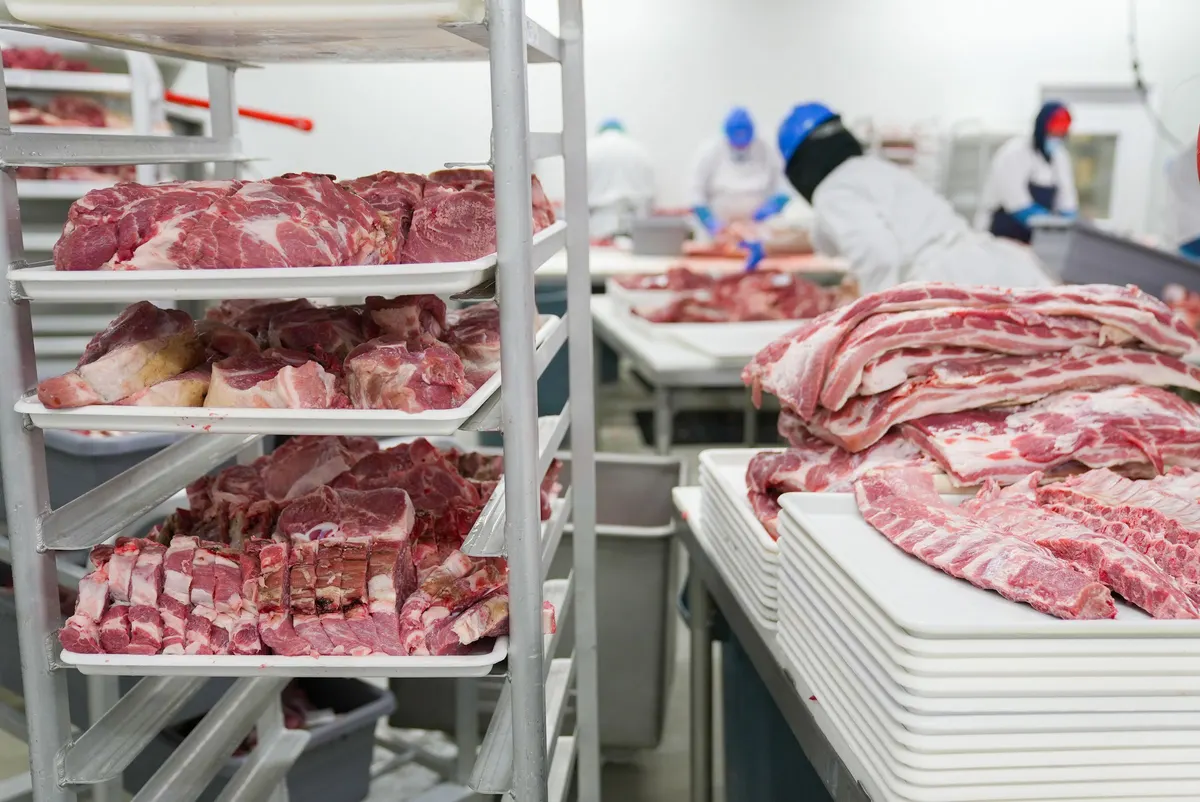
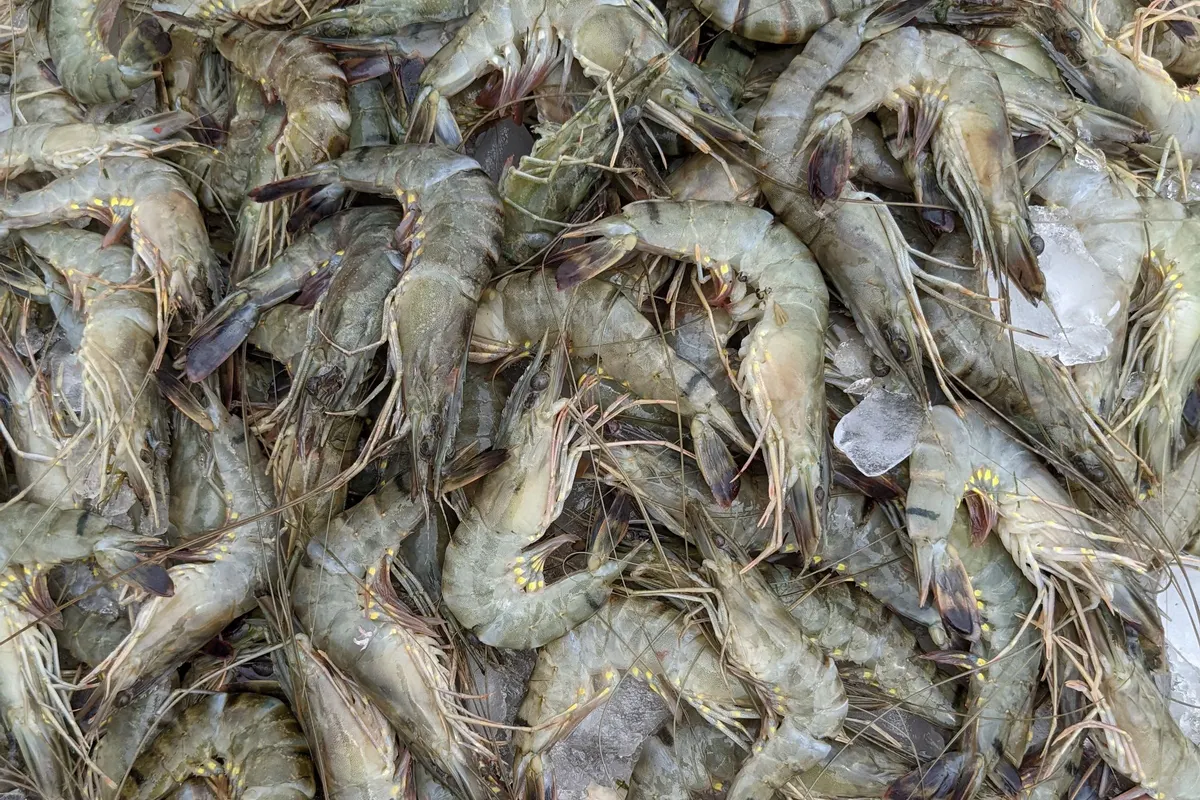
An expedition meal producer, one machine, one protein
A small outdoor-nutrition brand making freeze-dried meals for hiking and emergency stock, where protein is one component of a composite meal. On light commercial equipment from €8.950 ex-VAT at up to 18 kg fresh load, cooked chicken breast at roughly 2,9 kg per finished kilo returns about 6 kg of dried protein a cycle. European expedition meals retail around €90 to €135 per kilo of dried product, though that is the whole meal rather than the meat alone. The constraint sits upstream of the dryer: a validated cycle per protein, consistent piece size, and packaging that excludes oxygen for years.
A seafood processor drying its own trim
An established filleting operation looking at material it currently sells for very little. FAO puts fillet yields at roughly 28 to 55% of whole-fish weight, so a large share of every fish leaves the line as trim, and the EU fishmeal industry already takes most of its raw material from by-products. On commercial equipment from €13.950 ex-VAT at up to 50 kg fresh load, lean white-fish trim at roughly 5 kg per finished kilo returns about 10 kg a cycle, milled to a powder for soups, seasonings, ready meals and pet food. The honest limits: oily-species trim is a poor candidate, trim varies more than a fillet so validate against the worst case, and the approval question applies to the drying operation even where the filleting plant is approved.
Frequently asked questions
I buy meat already cut from an approved supplier and only dry it. Do I still need approval?
Yes, on the plain reading of the regulation. Your supplier's approval covers your supplier. Article 4(2) of Regulation (EC) 853/2004 applies to any establishment handling products of animal origin covered by Annex III, and a drying establishment is not among the exceptions in that paragraph. Drying preserves, so what you produce is a meat product or a processed fishery product in its own right. Take it to your Comunidad Autónoma in Spain or DGAV in Portugal before you order equipment.
Does freeze-drying kill bacteria or parasites?
No. It stops growth by removing available water; it does not sterilise. Lyophilisation is the standard way to preserve live bacterial cultures for decades. Published reductions from drying alone run around 1 to 2 log depending on the organism. Your kill step, if you need one, is heat applied before drying, and your ongoing control is water activity recorded per batch.
Do I have to freeze fish at −20 °C before freeze-drying it?
Possibly, and it is separate from the pre-freeze the process itself needs. Annex III, Section VIII, Chapter III, Part D of Regulation (EC) 853/2004 requires fishery products from finfish or cephalopod molluscs intended to be eaten raw, or treated insufficiently to kill parasites, to be frozen to −20 °C for at least 24 hours or −35 °C for at least 15 hours throughout. A freezer at −18 °C does not meet it and drying is not an exemption. You also have to issue a document stating the treatment applied.
Should I cook meat before freeze-drying it?
For most human-food applications, yes. Cooked meat rehydrates far better than raw, which matters for expedition meals, and it gives you a heat step you can validate and document. Cooking also removes water before the chamber does, so the cycle is shorter. The cost is yield: plan from cooked weight, not purchase weight.
How much raw material do I need per kilo of finished product?
From published USDA water content, roughly 2,8 kg of farmed salmon, 3,5 kg of lean beef, 3,6 kg of pork loin, 3,8 kg of chicken breast or yellowfin tuna, 4,6 kg of prawn, 4,7 kg of squid, 5,2 kg of mussel or 5,3 kg of cod, all raw. Cooked differs: about 2,9 kg for roasted chicken breast and 4,1 kg for cooked cod.
Can I freeze-dry salmon and other oily fish?
You can, and for many businesses you should not. Farmed Atlantic salmon is roughly 38% fat once the water is gone against about 4% for cod. Fat does not sublimate, it dries slowly, and the porous structure gives oxygen access to all of it. Budget for high-barrier packaging, inert-gas flushing or oxygen scavengers, sealing straight out of the chamber, and a shorter stated shelf life. If the product is price-sensitive and high-volume, look at smoking, canning or selling it frozen.
How long is a cycle?
It depends on the material, load thickness, fat content, piece size and target endpoint, so a single number quoted without those inputs is a guess. Fatty material takes materially longer than lean material of the same weight. Send us 2 kg of your actual product and we will measure it.
What water activity should I target, and how do I check it?
Design the endpoint comfortably below aW 0,92. At or under that figure, footnote (h) to Chapter 1 of Regulation (EC) 2073/2005 classifies a ready-to-eat product as unable to support Listeria monocytogenes growth, placing it under criterion 1.3 rather than 1.2. Check it on a bench water activity meter, per batch, and keep the records. A moisture percentage from weight loss is not a substitute: case-hardened product passes a weight check and fails on water activity.
How long does freeze-dried meat or fish last?
Lean, correctly dried and packed product holds for years, and the packaging determines that more than the drying does. Fat is the limiting factor; published work on freeze-dried mackerel and sardine found autoxidation fastest in the first three months. We will not put a single shelf-life number on your product. Establish it from your own stability testing on your own packaging.
What does a commercial freeze-dryer for meat or fish cost?
Compact machines start at €4.950 ex-VAT for up to 10 kg fresh load per batch, a first production line from €8.950 for up to 18 kg, and established production from €13.950 in the up-to-50 kg band. The entry industrial machine is €145.480 and larger units are quoted per project. Budget beyond the dryer: freezer capacity, cooking, slicing, water activity testing, high-barrier packaging and sealing, and premises that pass an approval inspection.
Send us your product, your volumes and your market.
Tell us what you want to dry, how much per week, whether it will be eaten cooked or as-is, and where you are. We will size the machine across all four manufacturers, run the numbers on your material, and point you at the right competent authority.
And if freeze-drying is the wrong process for your product, which for some fatty fish and some local chilled routes it is, we will tell you that instead. Better for both of us than a machine you regret.