
Freeze-Dryers for Fruit and Vegetables
Turn a perishable, price-volatile crop into a shelf-stable ingredient you control the margin on, and know before you buy whether the arithmetic works for your material.
Spain exported 12 million tonnes of fresh fruit and vegetables in 2025, worth €18,67 bn. It also discarded more than 480.000 tonnes before any of it reached a market between 2018 and 2024, mostly on cosmetic grade, calibre and price rather than on quality.
Freeze-drying is one of the few processes that takes that material and returns something worth more per kilo than the Class-I crop it was graded out of. Our own price reference puts freeze-dried strawberry at €71 to €93 a kilo at retail, against €3,82 a kilo for the fresh fruit. That gap exists and it is not free: at 11 kg of fresh strawberry per finished kilo, €42 of raw material sits inside every kilo you sell.
This page gives you the yield table, the price bands, the EU rules that actually apply, and the cases where we would tell you not to buy.
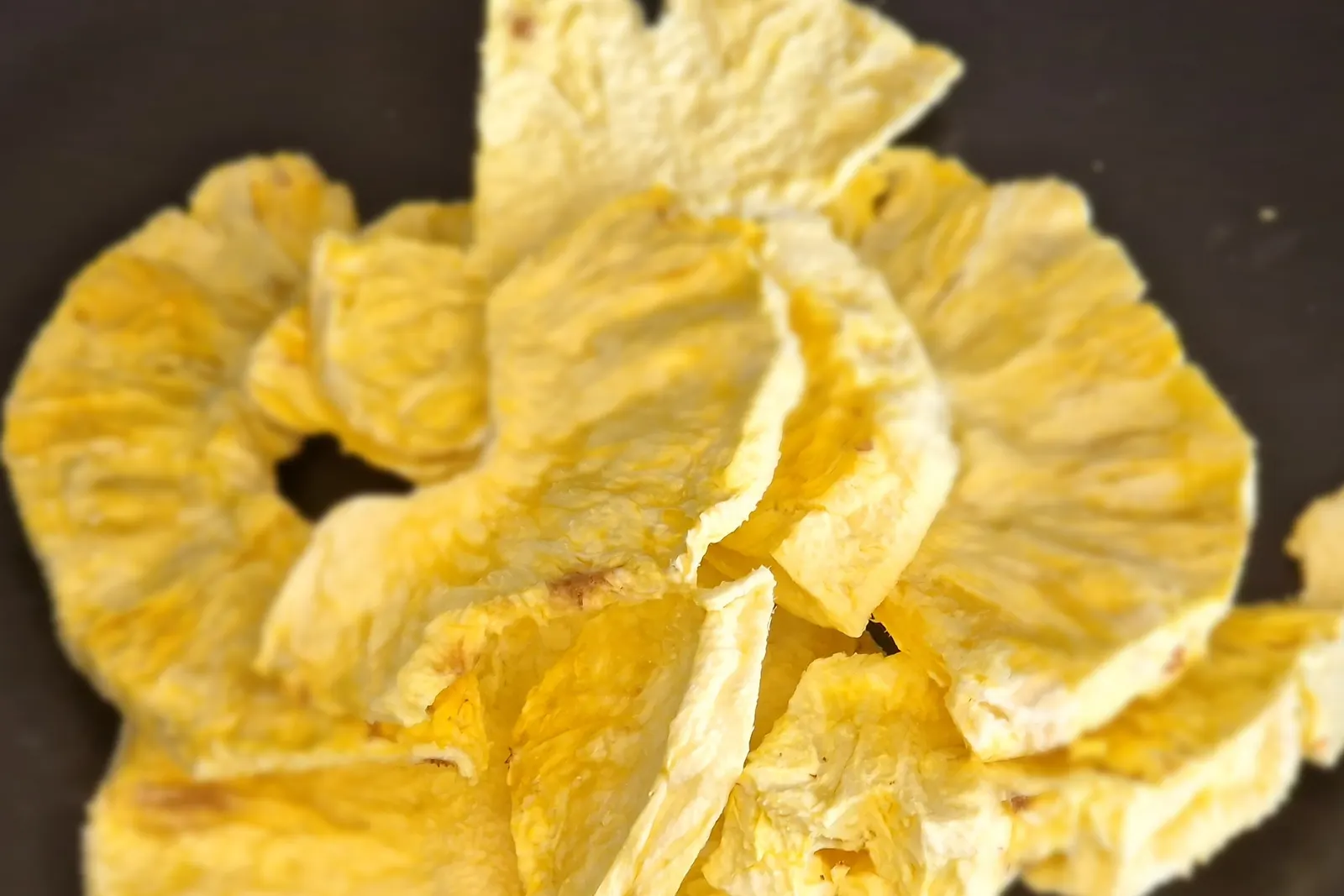
In short
Send us 2 kg. Get measured yield and cycle figures.
Everything on this page is calculated from published data. Your crop is not published data. Send us 2 kg of the material you actually intend to sell: the variety you grow or buy, at the ripeness you will run it at, cut to the piece size you plan to use.
You get back the measured yield, a realistic cycle plan for that material and a machine recommendation across all four manufacturers, plus the dried sample itself so you can see and taste what your crop becomes. If freeze-drying is the wrong process for your product, that is what we will tell you.
Which freeze-dryer for your scale
Capacity is fresh load per batch, meaning what goes in wet rather than what comes out dry. On strawberry, a machine rated up to 30 kg returns somewhere near 2,7 kg of finished product per cycle. Prices are ex-VAT list prices, pulled live from the catalogue.
| Stage | Fresh load per batch | Running cost | From | Representative models |
|---|---|---|---|---|
| Compact commercialR&D, first product, farm shop, own-crop surplus | Up to 10 kg | 0,9–1,4 kWh/h | €4.950 | |
| Light commercialfirst real production line, one or two lines | Up to 18 kg | 1,13–2,46 kWh/h | €8.950 | |
| Commercialestablished production, seasonal peaks, co-operative volumes | Up to 50 kg | 2,25–3,59 kWh/h | €13.950 | |
| Industrialfactory scale, contract drying, ingredient supply | Up to 600 kg | 4–13 kWh/h | €145.480 |
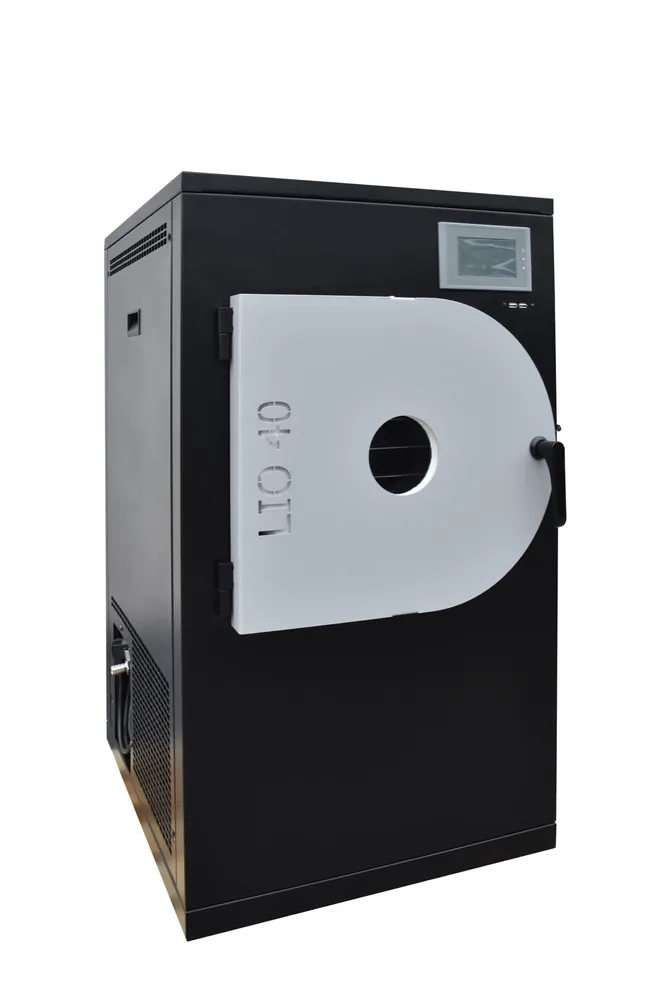
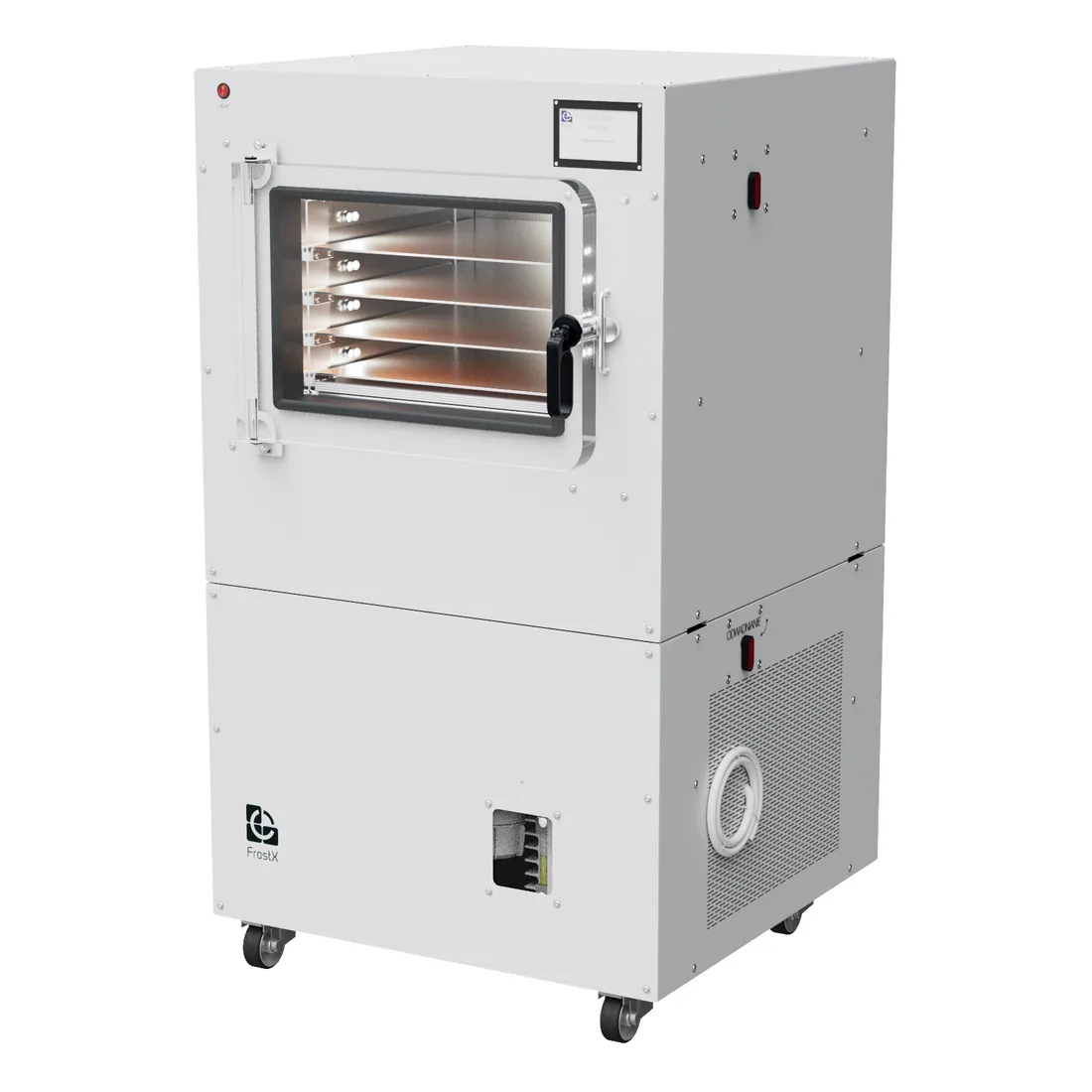
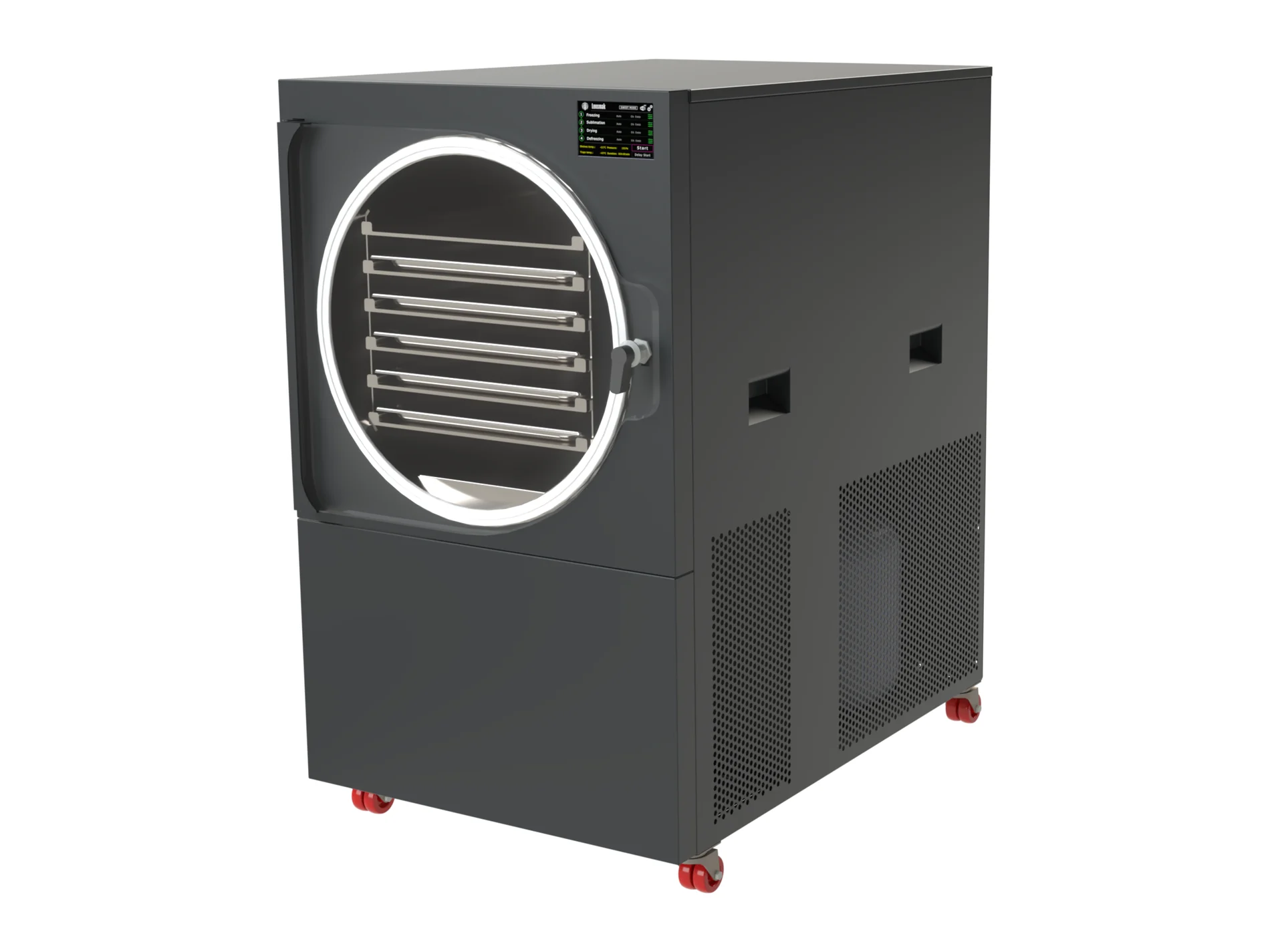
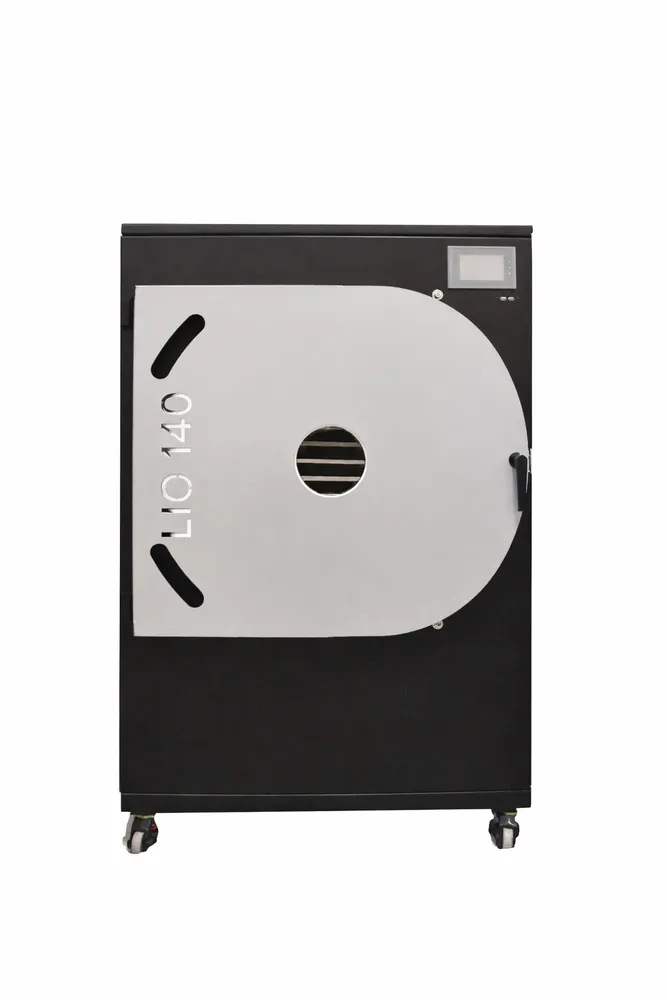
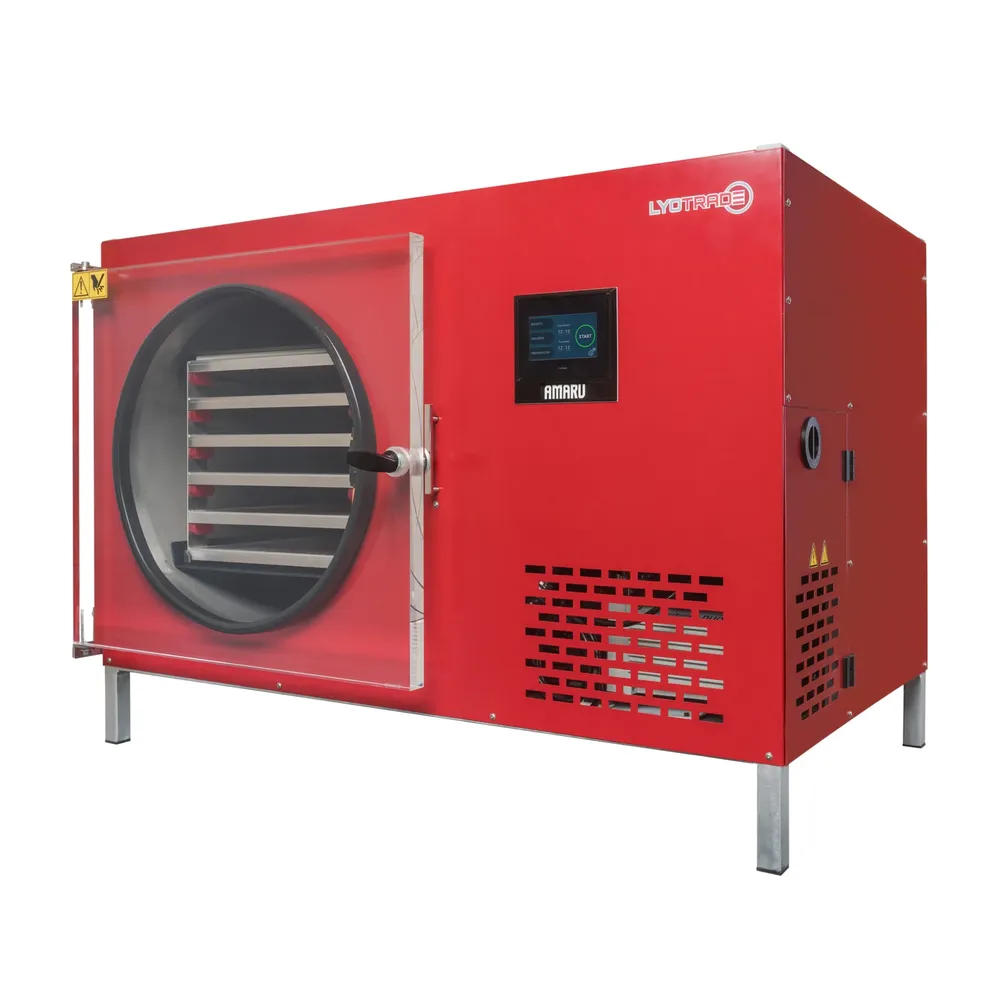
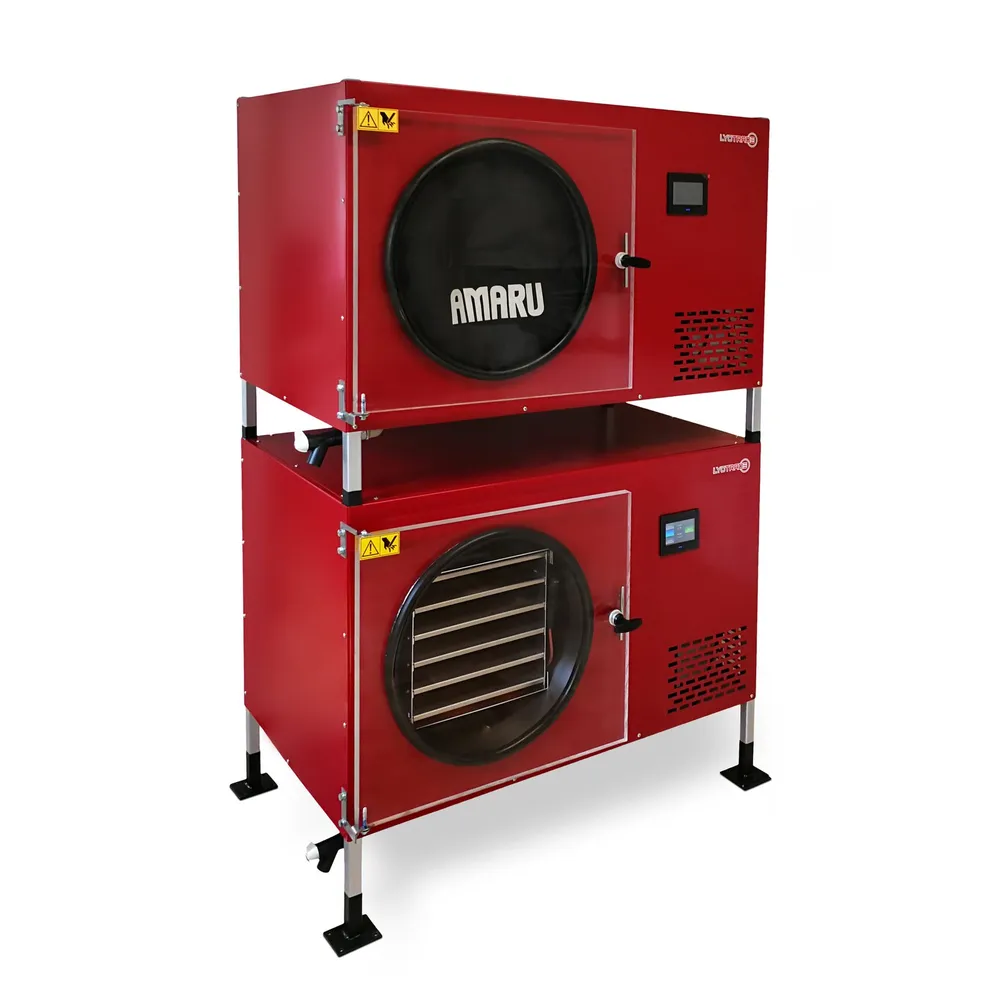
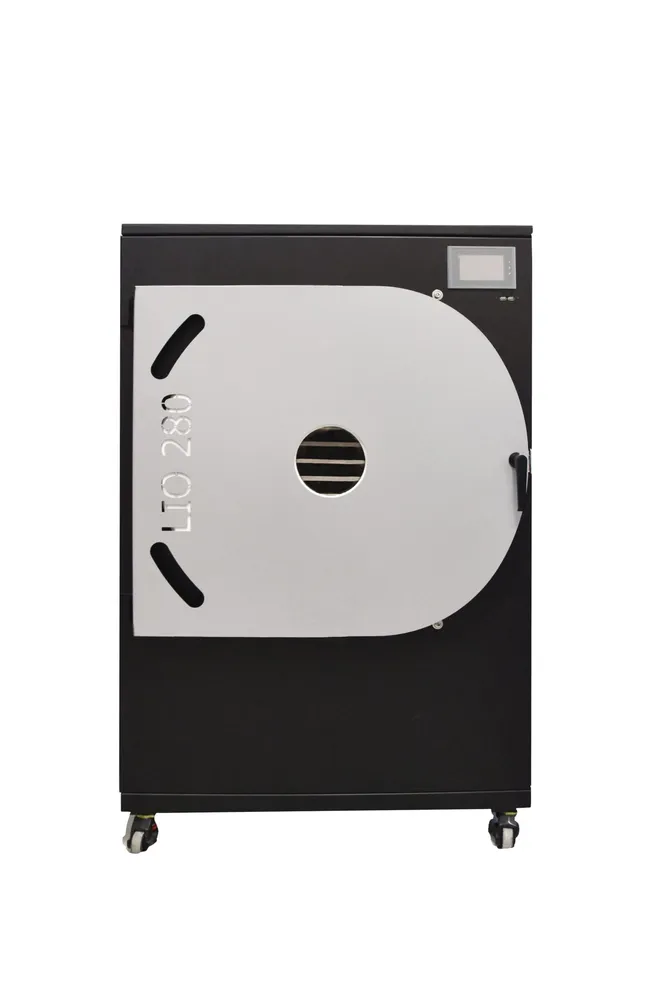
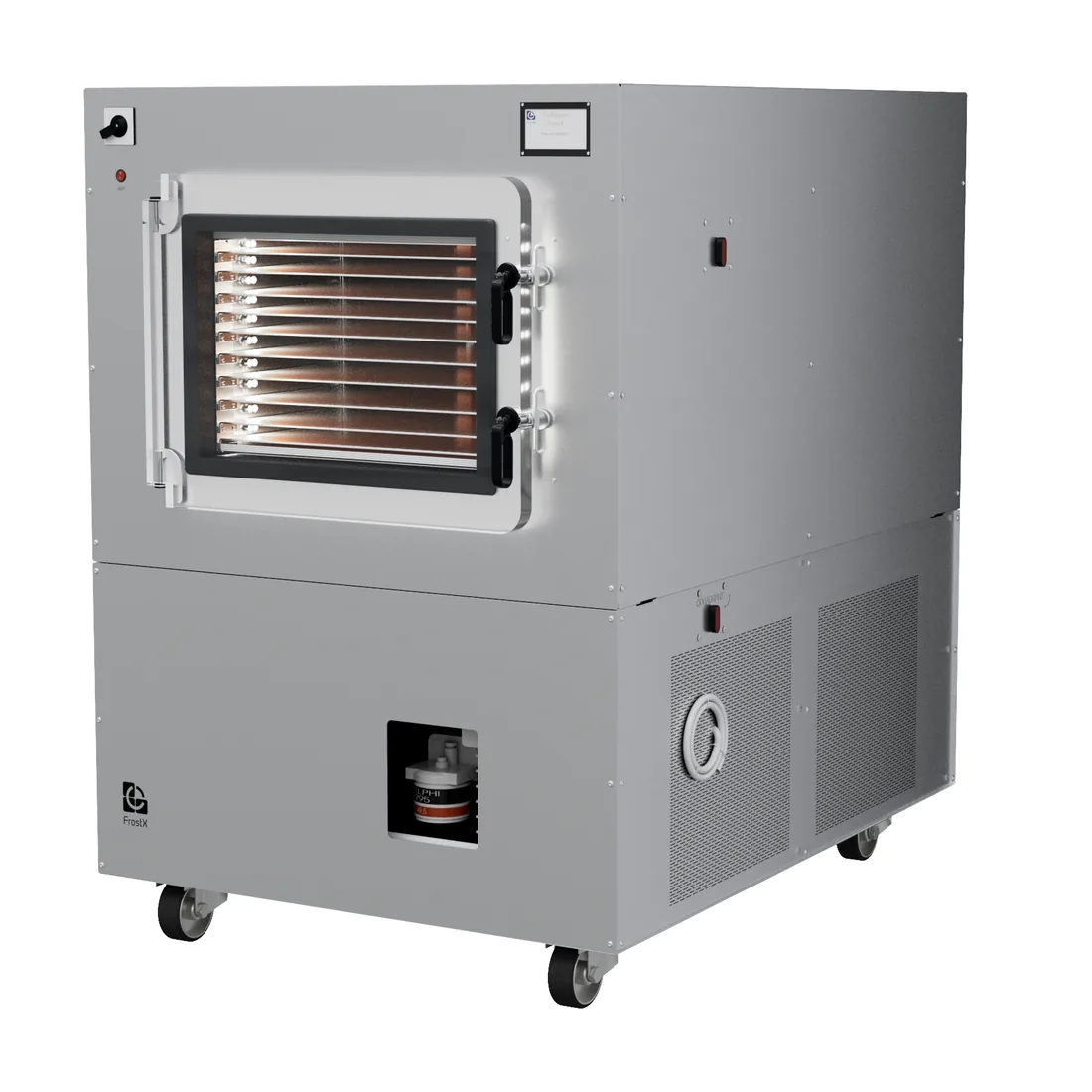
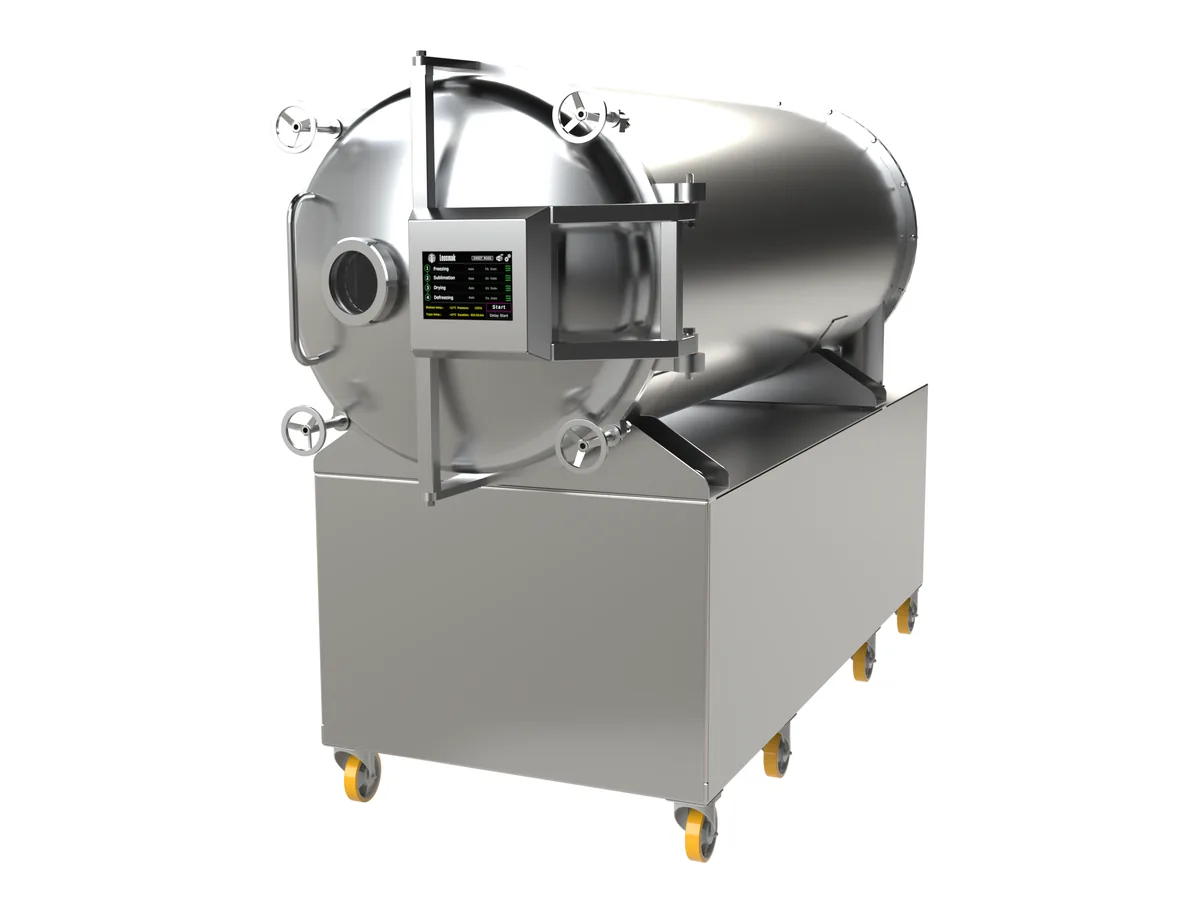
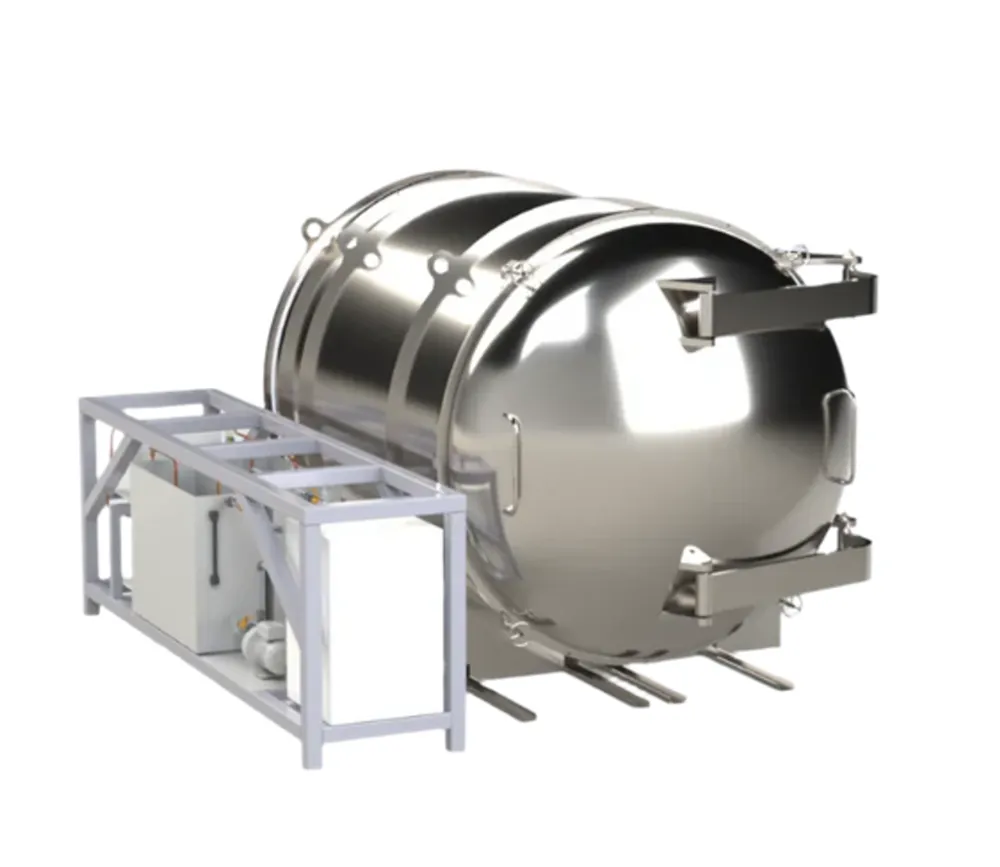
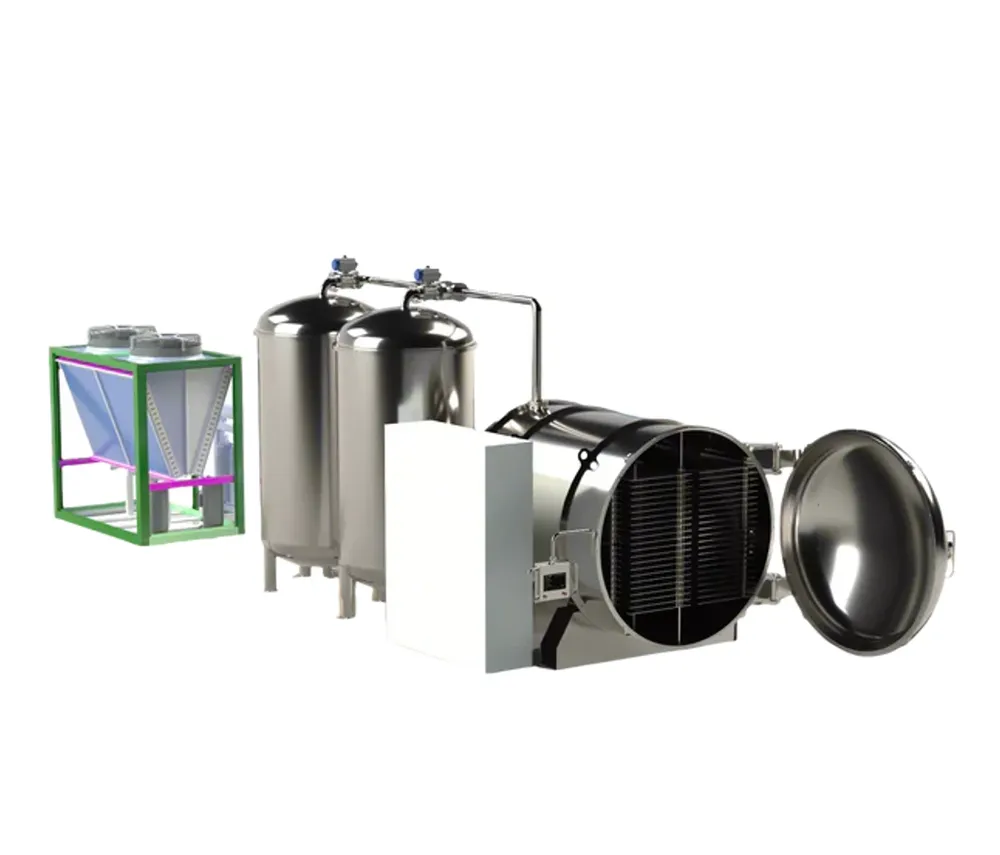
Running cost is average energy consumption across each band. FrostX machines are sold as normal but carry no energy figure until the manufacturer supplies one. Three things to check inside a band. Condenser capacity, not shelf area, is what limits you on fruit, so ask for the ice-condenser figure and size it against your wettest crop. Shelf gap decides whether you can run whole fruit or only slices and it varies across the range, so tell us the format as well as the crop. Freezer capacity ahead of the dryer is part of the purchase rather than an accessory: your crop arrives in a few weeks and the chamber runs all year, and new entrants routinely forget to budget for it.
Yield and what the input costs
Freeze-drying removes water and fruit is mostly water, so machine capacity is quoted as fresh load per batch and the ratio below is what turns a specification into a business plan. These are our own published figures, the same ones behind the ROI calculator, and they allow for trim and peeling loss.
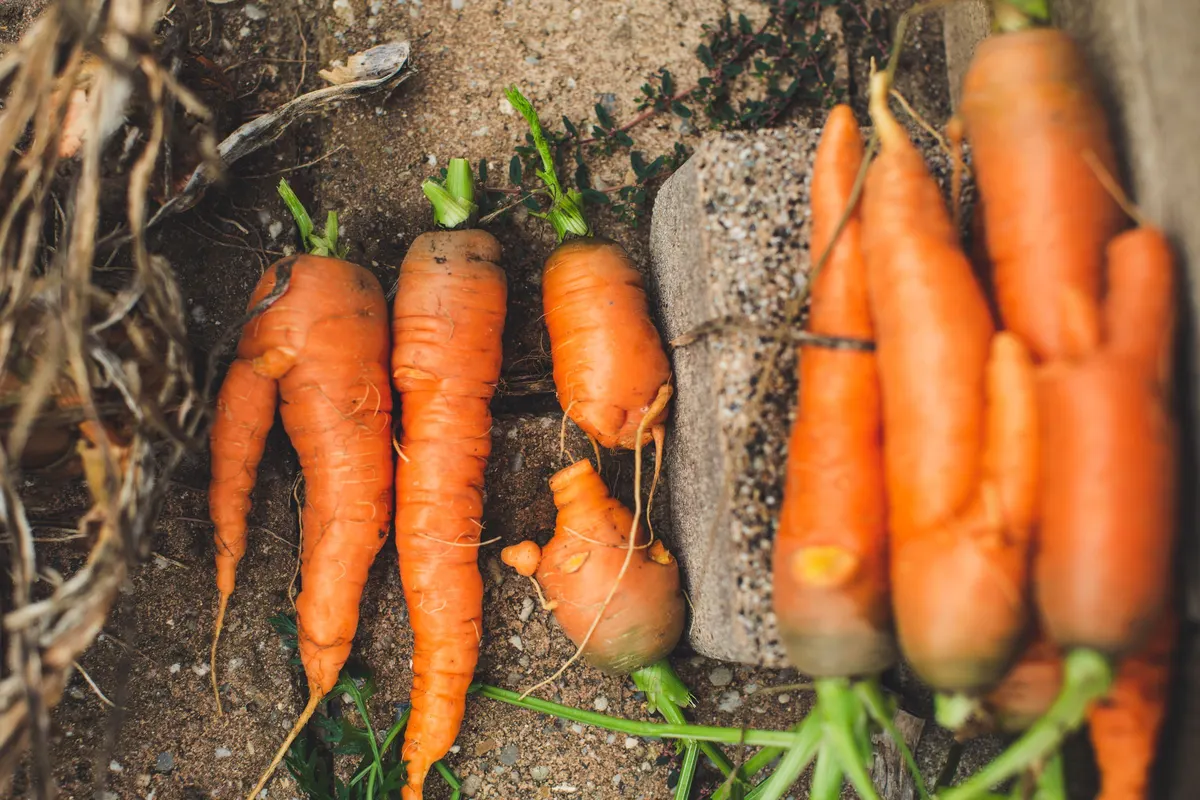
Two consequences. Capacity is quoted wet. A machine rated up to 30 kg fresh load returns roughly 2,7 kg of finished strawberry, or roughly 7,5 kg of finished banana, per cycle, so size on the finished number. The input cost follows the ratio, not the headline fruit price. Carrot at €0,40 a kilo and 10:1 puts €4 of raw material into a finished kilo; strawberry at €3,82 and 11:1 puts in €42. Fresh prices for eight of these materials refresh automatically from EU Commission wholesale data. See the full table, with retail and B2B reference prices
| Raw material | Fresh €/kg | Fresh input per 1 kg finished |
|---|---|---|
| Banana | €1,39 | ~4 kg |
| Mango | €2,24 | ~6 kg |
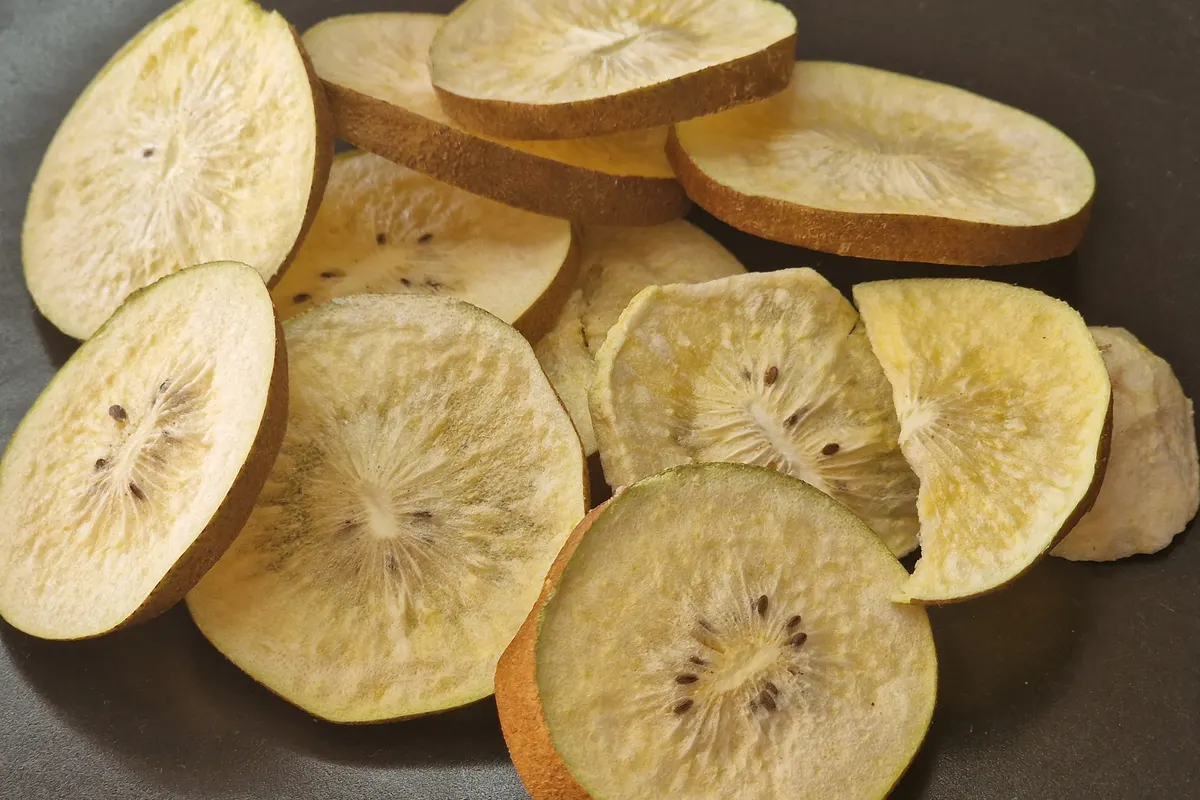
| Kiwi | €2,36 | ~6 kg |
| Apple | €1,12 | ~8 kg |
| Pineapple | €1,23 | ~8 kg |
| Carrot | €0,40 | ~10 kg |
| Dragon fruit | €5,38 | ~10 kg |
| Strawberry | €3,82 | ~11 kg |
What decides whether this works
Colour retention, shelf life and light weight are true, and every competitor says them, so they carry no information. These four things set your cost per kilo. One of them is a reason not to buy.
Yield governs everything, and fruit has the worst of it
Machine capacity is quoted as fresh load. Your finished output is what remains after 90-something percent of the mass has left as water vapour. A very wet crop occupies the same chamber, the same shelf area and the same condenser duty as a drier one, and hands you a fraction of the saleable output. Overloading a tray to claw the difference back costs more hours than the extra kilos are worth, and leaves an uneven end-point across the batch. Price your chamber time by finished kilo, never by fresh kilo.
Sugar makes fruit collapse
High-sugar fruit such as mango, banana, pineapple and ripe berries has a low collapse temperature in the frozen state. Push the product above it during primary drying and the structure gives way: the piece shrinks, goes sticky, browns and rehydrates badly. You get a sweet brown wafer instead of a strawberry. The fix is a gentler, longer cycle held below that temperature, specific to the crop and the ripeness. It is also why we will not quote you a cycle time for fruit.
Drying concentrates everything, including what you do not want
Taking 11 kg of water out of 11 kg of strawberry does not remove the pesticide residue, the heavy metals or the mycotoxins. It concentrates them into the kilo that is left. EU maximum residue levels under Regulation (EC) No 396/2005 are set on the raw commodity. Article 20 allows changes caused by processing to be taken into account, but the Commission has never established Annex VI, so there is no legal EU list of processing factors: its own information note, SANTE/10704/2021 Rev 1 of 19 March 2025, states that the empowerment has not been used. In practice a residue that passes comfortably on fresh fruit can fail on the dried product. Know your grower's spray record before you buy the fruit, not after you have dried it.
Buying fruit at market price usually does not work, and that is the argument against a machine
Do the arithmetic before anything else. At 11:1 and €3,82 a kilo, €42 of fresh strawberry sits inside every finished kilo. Against our B2B reference of €51 that leaves €9 before labour, energy, packaging, depreciation or waste. Against a retail price of €79 it is a business, but only if you can actually reach retail. Cheap, low-ratio crops behave completely differently: carrot puts €4 of input into a kilo that retails around €65, apple €9 into €64, pineapple €10 into €86. If you are planning to buy Class-I berries at market and sell into bulk, tell us and we will tell you not to buy. The producers who make this work are almost always drying material they already own, or selling the finished product themselves.
What applies before you sell
This is the shortest regulatory route of any industry we serve, and we say so plainly because buyers arriving from the meat or pet-food side expect worse. Fruit and vegetables are food of non-animal origin, which means registration of your establishment rather than approval with a pre-production inspection. Article numbers are given so you can read the source and take it to your authority.
Registration, not approval
Article 6 of Regulation (EC) No 852/2004 requires every food business operator to notify the competent authority of each establishment under their control, for registration. Approval under Regulation (EC) No 853/2004 applies to products of animal origin and does not reach a plant-only freeze-drying operation. If you dry anything of animal origin in the same room, that changes and the harder route applies.
HACCP-based procedures
Article 5 of Regulation (EC) No 852/2004 requires procedures based on HACCP principles, on top of the general hygiene requirements in Annex II. For a freeze-drying operation the critical control point is normally water activity, verified per batch on a bench meter you own, not a weight-loss reading. Weight loss tells you about mass and nothing about microbiological stability. Budget for the meter: it is your release record, and no equipment supplier can produce it for you.
Novel food does not apply, with one exception
Conventional fruit and vegetables consumed to a significant degree in the EU before 15 May 1997 are not novel foods, and freeze-drying is a conventional preservation process, so Regulation (EU) 2015/2283 puts no hurdle in front of dried Spanish strawberry. There is one exception. An exotic species with no EU consumption history before that date, or an isolate or extract rather than the whole dried fruit, can fall inside the Novel Food regime. If you are working with something unusual, check before you commit.
Residues, contaminants and labelling
Pesticide MRLs (Regulation (EC) No 396/2005) and contaminant limits (Regulation (EU) 2023/915) apply to the product as placed on the market, and drying concentrates both. Labelling follows Regulation (EU) No 1169/2011, including a nutrition declaration calculated on the dried product rather than the fresh one, which is a common and expensive error. Organic claims need you certified as a processing operator under Regulation (EU) 2018/848; your grower's certificate does not cover your drying step.
Where to apply
— Entry in the RGSEAA under Real Decreto 191/2011. You apply to the health authority of your Comunidad Autónoma, not to AESAN directly: AESAN maintains the register, the autonomous community processes you. Fruit and vegetable processing sits under clave 21, and the activity codes govern what you may then label, so confirm the exact clave with your community. Note also Ley 1/2025 on food loss and waste (BOE-A-2025-6597), whose general obligations apply from April 2026: valorising surplus is now a compliance activity as well as a commercial one.
— Registration with DGAV under Article 6 of Regulation (EC) No 852/2004, through the dedicated route for food of non-animal origin. Applications go via the +SIPACE system with the registration form and proof of licensing, and DGAV publishes the list of registered operators. ASAE inspects and enforces but does not register. You will also need the industrial-activity permit for the premises through the Balcão do Empreendedor before DGAV can complete your registration.
Orientation, not legal advice. Every reference above is given so you can read the source and take it to your competent authority. Confirm your case before you invest: a machine you cannot legally run is worthless. Checked against consolidated EU texts and national sources in August 2026.
What you can produce
A tropical-fruit producer in the Canary Islands
A Spanish producer working with tropical fruit bought one machine in March 2026 to dry their own crop rather than move all of it fresh. On an island the logistics are the business case. Around nine tenths of the weight leaves as water vapour, so what ships is a fraction of the mass, at ambient temperature, with no cold chain and no clock running on it. The fruit is stabilised at the ripeness it was picked at instead of degrading in transit, and the finished product sells all year instead of only during the harvest window. Tropical fruit is also the textbook high-sugar case: it dries well, but only on a cycle held below its collapse temperature, and it rewards a producer who owns the crop rather than buying it in.
A certified-organic dragon fruit grower in Valencia
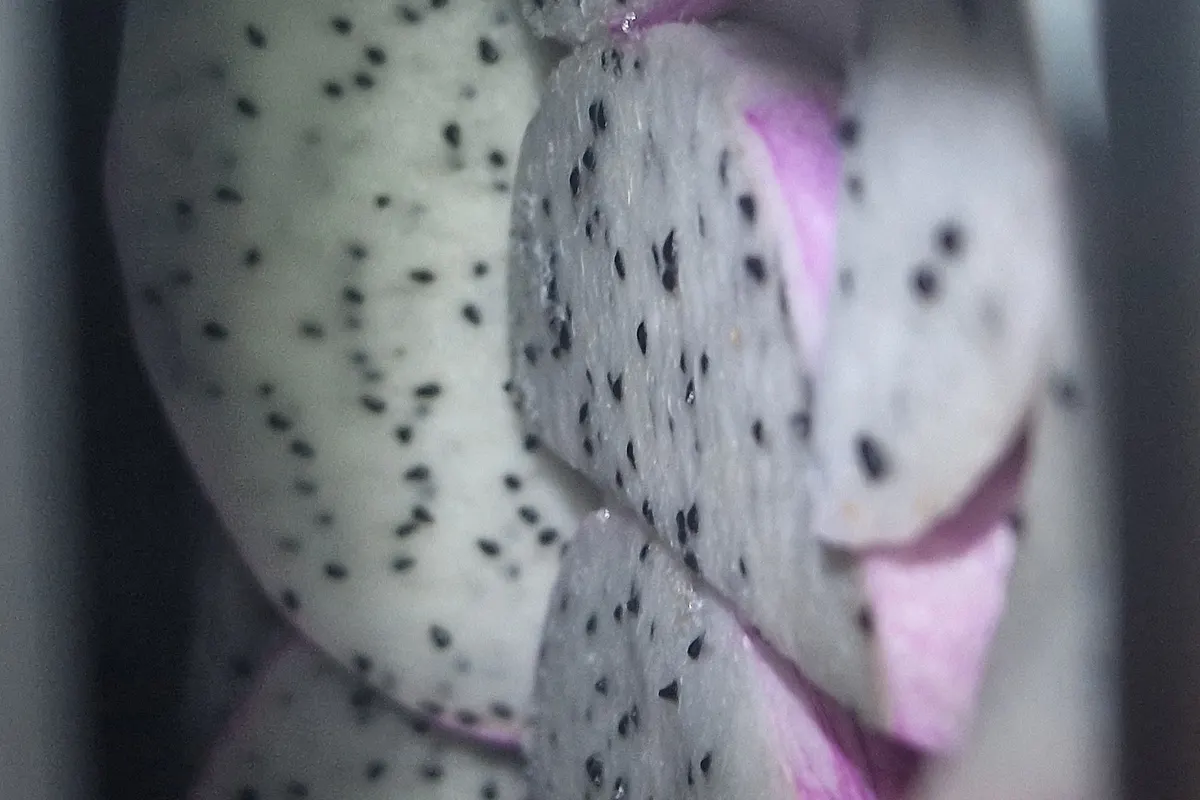
An organic grower drying part of the dragon fruit harvest instead of selling all of it fresh into a market where someone else sets the price. Dragon fruit is a 10:1 crop at €5,38 a kilo fresh, so the input cost is real, but it is also one of the highest-value dried fruits we publish, at €86 to €103 a kilo at retail. Organic growers hit the surplus problem harder than conventional ones: the price premium is higher, the cosmetic tolerance of the retail channel is no wider, and out-grade organic fruit is expensive material to throw away. This deal turned on one point: organic certification of the drying step is separate from the grower's own certification. That question had to be settled before the machine was ordered, and it should be settled before yours is.
Frequently asked questions
How much fresh fruit do I need per kilo of finished product?
Roughly 4 kg of banana, 6 kg of mango or kiwi, 8 kg of apple or pineapple, 10 kg of carrot or dragon fruit and 11 kg of strawberry. These are our own published figures, the same ones behind the ROI calculator, and they allow for trim and peeling loss. This is the single most important number in your business plan, and a machine capacity rating does not tell you it.
How long is a freeze-drying cycle for fruit?
It depends on the crop, the sugar content, the ripeness, the piece size, how deep you load the tray and the moisture you are drying down to. High-sugar fruit has to be held below its collapse temperature, which lengthens the run considerably compared with a lean vegetable. Any supplier who gives you a single number for fruit is guessing. Send us 2 kg of your actual material and we will run it and measure it.
What does a commercial freeze-dryer for fruit cost?
Compact commercial machines start at €4.950 ex-VAT. A first production line starts at €8.950. Established production in the up-to-50 kg band starts at €13.950. Factory-scale units start at €145.480, with the two largest quoted per project. Every list price sits on its product page and updates live. What the finished product sells for is published too, by material, on our prices page.
Does freeze-drying keep the vitamins and the colour?
It retains far more than hot-air drying, because there is no heat-driven browning and no evaporative concentration step. Around 97% nutrient retention is the figure the category works to, and colour and shape hold up because the structure is dried from the frozen state rather than shrunk. What it does not do is improve anything. A pale, under-ripe strawberry freeze-dries into a pale, under-ripe product. Raw material quality is still the ceiling.
Can I freeze-dry surplus or Class-II fruit?
Yes, and it is usually the strongest commercial case. Cosmetic downgrades, calibre rejects and gluts are the same fruit at a fraction of the price, and once it is dried, and especially once it is milled to powder, the cosmetic grade stops being visible. The fruit still has to be sound and food-safe, and it still has to meet residue and contaminant limits, which drying concentrates. Surplus does not mean spoiled.
Do I need a licence or approval to sell freeze-dried fruit in the EU?
You need your establishment registered under Article 6 of Regulation (EC) No 852/2004 and HACCP-based procedures under Article 5. You do not need the approval procedure that applies to products of animal origin. In Spain that means an RGSEAA entry filed through your Comunidad Autónoma; in Portugal, a DGAV establishment registration. Orientation only, so confirm with your competent authority.
Is freeze-dried fruit a novel food?
No, not for conventional fruit and vegetables with a history of significant consumption in the EU before 15 May 1997. Freeze-drying is a conventional preservation process and does not by itself trigger Regulation (EU) 2015/2283. The exceptions are exotic species with no pre-1997 EU consumption history, and isolates or extracts rather than the whole dried fruit. If that is your product, check before you commit capital.
How long does freeze-dried fruit keep?
Shelf life of up to 25 years is achievable without additives or refrigeration when moisture is driven to 98 to 99% removal and the product is sealed in oxygen-barrier packaging. In commercial practice most producers state one to three years, because that is what their packaging and their turnover support. The limiting factor is almost never the drying. It is moisture re-uptake and oxygen ingress: freeze-dried fruit is hygroscopic and will pull water out of the room while you are packing it.
What does it cost to run?
Between about 0,9 and 3,6 kWh per hour across the compact, light commercial and commercial bands, and 4 to 13 kWh per hour at industrial scale. Electricity is rarely the number that decides this. Raw material cost per finished kilo and chamber occupancy per finished kilo dominate: on strawberry bought at market the fruit alone can be most of your bulk selling price.
Should I buy a freeze-dryer or send my fruit to a contract dryer?
If you are testing a product, validating a market, or running one seasonal line below a couple of tonnes of finished output a year, contract drying is often the better answer and we will say so. Buying makes sense when you have a continuous or reliably seasonal input stream you already own, when you need control over the cycle for a specific format, or when you need the drying step inside your own certification and traceability. Tell us your volumes and we will give you a straight view.
Send us your crop and your volumes.
Tell us what you want to dry, how much per week or per season, whether you own the material or buy it, and where you are. We will size the machine across all four manufacturers, run the cost-per-finished-kilo maths with you against our published prices, and point you at the right registration route for Spain or Portugal.
And if the arithmetic does not work, which it does not when you would be buying Class-I fruit at market to compete with imported commodity powder, we will tell you that instead of selling you a machine. It is a shorter conversation and a better one.